
Landing Pages for Local SEO: When They Help and When They Become a Problem
Useful local pages can help customers and search visibility, but only when each one has a genuine reason to exist.
Introduction
A landing page can be one of the most useful pages on a small business website - or little more than another URL created to catch a Google search.
Used properly, landing pages help people find exactly what they need. They can focus on a particular service, location or type of customer and give someone arriving from Google a page that closely matches what they were looking for.
But it is easy to go too far.
A handful of useful local pages can quickly become dozens of near-duplicates targeting every town within driving distance.
Google specifically warns against practices such as doorway abuse and keyword stuffing, so where is the line between a useful local landing page and one created mainly for search engines?
Quick Answer
A good landing page should exist because it is useful to the person visiting it.
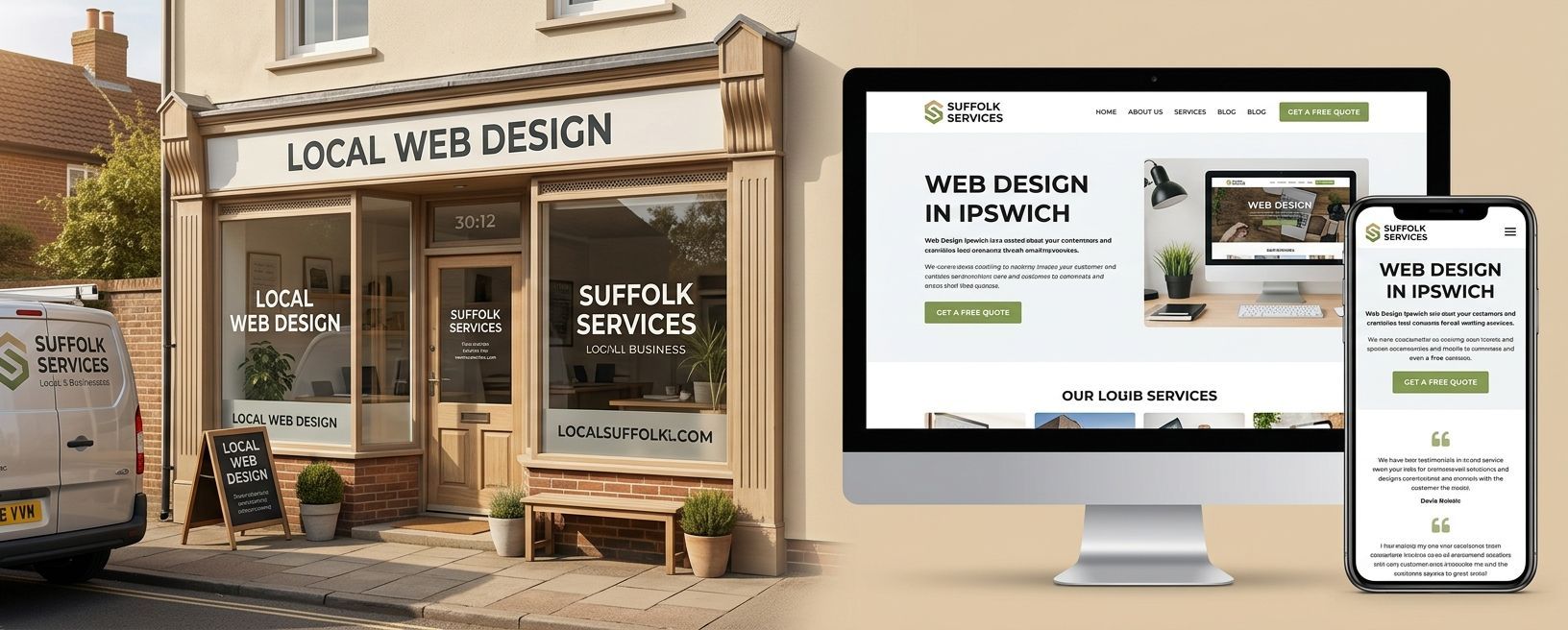
A local page for Web Design in Ipswich, for example, can make sense if I genuinely work with businesses in Ipswich and can provide information that is particularly relevant to someone looking for that service there.
Creating another 30 pages for every town and village within 40 miles, changing little more than the place name, is very different.
My approach is simple:
Create fewer, better landing pages where there is a genuine reason for each page to exist.
In This Article
- What is a landing page?
- Why can landing pages be useful?
- How should a good landing page be written?
- Where can local landing pages go wrong?
- What should you avoid?
- What does Google actually say?
- My approach to landing pages
- What changes technically on a local landing page?
- Landing pages should be destinations, not bait
- Do you need more landing pages, or better ones?
What Is a Landing Page?
Technically, any page someone first arrives at can be described as a landing page.
For SEO and marketing, I find it more useful to think of one as a page built around a particular need or something specific the customer is looking for.
That might be:
- a particular service
- a particular product
- a specific type of customer
- a geographical area
- a particular problem or requirement
For a local business, that could mean pages such as:
- Loft Conversions in Suffolk
- Caravan Storage near Ipswich
- Web Design in Ipswich
- Commercial Decorating Services
- Secondary Double Glazing
The purpose isn't simply to create another URL.
It is to give someone a useful destination that closely matches what they are looking for.
It also reflects an important principle from my Small Business Website Checklist: every important page should be capable of working as another front door into the business.
Why Can Landing Pages Be Useful?
They match the customer's search more closely
Someone searching for caravan storage near Ipswich probably doesn't want to arrive on a generic homepage and start hunting for information.
A dedicated page can immediately answer the questions that matter:
- Where is the site?
- How secure is it?
- How much does it cost?
- When can I access my caravan?
- What facilities are provided?
- How do I enquire?
The visitor gets a page that closely matches what they were looking for rather than having to find the information themselves.
They allow you to explain important services properly
Trying to put every service onto one page often means each one receives little more than a paragraph.
A dedicated service page gives you room to explain what you actually provide, answer common questions, discuss options, show examples and demonstrate your experience.
It also gives the rest of your website somewhere useful to link to. A related article, for example, can point someone towards the relevant service rather than continually sending visitors back to the homepage.
Google recommends using descriptive internal links to help people and Google understand how pages on a website relate to one another.
They can strengthen genuine local relevance
Location matters to many small businesses.
A builder may regularly work in Ipswich, Sudbury and Hadleigh. A caravan storage business may be outside Ipswich but particularly convenient for customers travelling from certain parts of the town.
A useful local page can explain that relationship.
It might include the areas covered, relevant projects, travel considerations, nearby locations or examples of work.
The local information should be there because it helps the customer, not simply because someone searched for the town name.
They provide better destinations for other marketing
Landing pages aren't only about Google.
They can provide useful destinations for:
- Google Business Profile posts
- email campaigns
- online directories
- paid advertising
- related articles
Instead of continually sending everyone to the homepage, you can take people directly to the information that prompted them to click.
This is part of the wider approach explained in Your Website as the Hub: Building a Connected Local Online Presence, where the website becomes the central source of detailed information and the rest of your online presence helps people find the most relevant parts of it.
How Should a Good Landing Page Be Written?
I would start with the same question I use for most website content:
What would somebody arriving on this page actually want to know?
Not:
How many times can I get the target keyword onto this page?
Start with a clear opening
Tell people immediately what you provide, who it is for and, where relevant, where you provide it.
Don't make visitors work out whether they have arrived at the right place.
Use your real business knowledge
This is where much of the most useful content comes from.
- What do customers ask you on the phone?
- What are they unsure about?
- What choices do they need to make?
- What affects the price?
- What problems do they commonly encounter?
- What do you find yourself explaining repeatedly?
Those answers are usually far more valuable than adding words simply to make a page longer.
Google's guidance specifically warns against writing to a particular word count because you've heard that Google prefers one. It doesn't.
Google: Creating Helpful, Reliable, People-First Content
Demonstrate rather than simply claim
If you say you have experience in a particular service or area, show it where you can.
That might include:
- photographs of completed work
- relevant projects
- customer reviews
- case studies
- qualifications
- accreditations
- examples of your work
- useful advice based on experience
The more clearly a page connects its claims to the real business behind it, the more useful and convincing it becomes.
Make local information genuinely useful
A location page doesn't need a potted history of the town.
If you're a roofer, someone looking for a roofer in Ipswich probably doesn't need to know when Ipswich received its first royal charter.
They may want to know whether you cover their area, examples of nearby work, what services you provide and how they can arrange a visit.
Local content should be useful, not decorative.
Give people an obvious next step
Once you've answered someone's questions, make it easy for them to:
- request a quotation
- call
- send an enquiry
- view previous work
- read a related guide
- find another relevant service
A landing page should help someone move forward, not simply attract a visit.
Where Local Landing Pages Can Go Wrong
Imagine a roofer covering Suffolk.
Someone suggests creating:
- Roofers Ipswich
- Roofers Sudbury
- Roofers Hadleigh
- Roofers Stowmarket
- Roofers Woodbridge
- Roofers Bury St Edmunds
- Roofers Felixstowe
There is nothing inherently wrong with having pages for different locations.
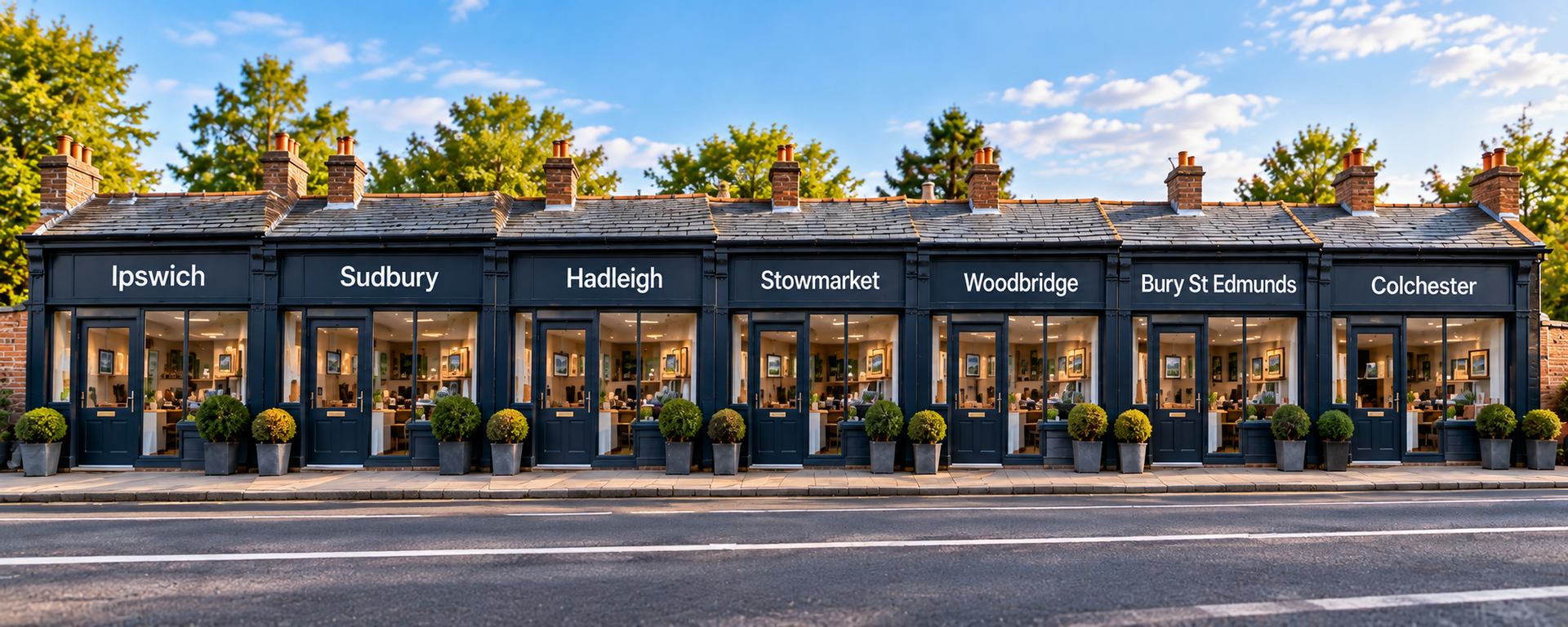
The problem comes when the same page is copied seven times and the town name is changed. Perhaps a paragraph about each town is added to make the pages look different.
You now have seven URLs.
But have you actually created seven useful resources?
It's a little like building seven identical shops next to each other and simply changing the sign above each door.
More doors don't necessarily make the shop more useful.
What Should You Avoid?
I would be particularly cautious about:
- creating a page for every nearby town simply because people search for it
- copying a page and replacing one town name with another
- repeatedly forcing phrases such as “builder Ipswich” or “SEO Suffolk” into the copy
- adding long lists of towns primarily for search engines
- writing irrelevant local history to make pages appear different
- padding pages to reach an assumed SEO word count
- creating lots of pages that answer exactly the same questions in exactly the same way
Mention the places you genuinely serve.
Just don't mistake repeating a place name for useful local content.
What Does Google Actually Say?
There isn't a simple Google rule saying every local business should — or shouldn't — have location landing pages.
Its broader guidance is more useful.
Google recommends creating helpful, reliable, people-first content and warns against content created primarily to attract visits from search engines.
Read Google's guidance on creating helpful, reliable, people-first content
Its spam policies are particularly relevant to local landing pages.
Google describes doorway abuse as creating sites or pages to rank for specific, similar search queries that lead people to pages that are less useful than the final destination. Importantly for local SEO, its examples specifically include pages targeted at particular regions or cities that funnel visitors towards one page.
Read Google's guidance on doorway abuse
Google's guidance on keyword stuffing is relevant too. Its examples include blocks of text listing cities and regions that a page is trying to rank for.
Read Google's guidance on keyword stuffing
That doesn't mean a business with separate pages for Ipswich, Sudbury and Bury St Edmunds is automatically doing something wrong.
The more useful question is:
Would someone in this location benefit from having a page specifically about this service and this area?
If the answer is yes, build it properly.
Give the page a genuine purpose. Include information that matters to someone in that area, such as relevant services, examples of nearby work, areas covered, photographs, customer questions or practical information.
If the only meaningful change from your existing page would be replacing one place name with another, I'd question what the additional page achieves.
That also leads to another useful test:
Would I still want this page on my website if Google didn't exist?
If the page would still help a potential customer understand your business, your services or whether you cover their area, there is probably a good reason for it to exist.
Creating more pages isn't a substitute for making the important ones useful, accessible and understandable, something I look at more broadly in Why Is My Business Not Showing on Google?.
My Approach to Landing Pages
I don't think businesses should treat landing pages as a numbers game.
I'd rather create five genuinely useful pages than fifty near-duplicates.
For a local service business, I'd normally start with the main services and geographical areas that matter, then consider each additional page on its own merits.
Ask:
- Do we genuinely provide this service or cover this area?
- Is there a real customer need for this page?
- Can we add useful information that isn't already covered elsewhere?
- Do we have relevant experience, photographs, projects or reviews?
- Can we answer questions specific to this service or location?
- Does the page have a clear place within the rest of the website?
- Would I still want this page on my website if Google didn't exist?
That last question is particularly useful.
If the page would still help a potential customer understand the business, its services or whether it is suitable for them, you probably have a good reason to create it.
If its only real purpose disappears when you remove Google from the equation, I'd question why it exists.
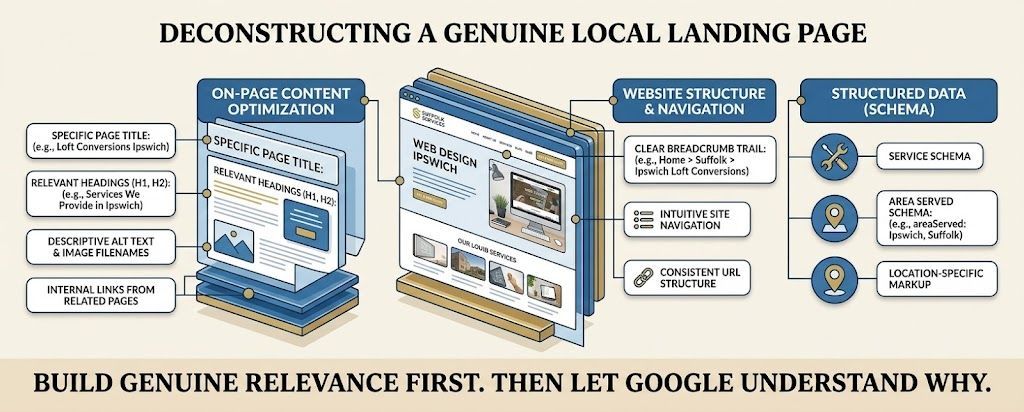
What Changes Technically on a Local Landing Page?
If I create a genuine local landing page, I don't just change the town name in the text.
The supporting SEO should reflect that individual page too.
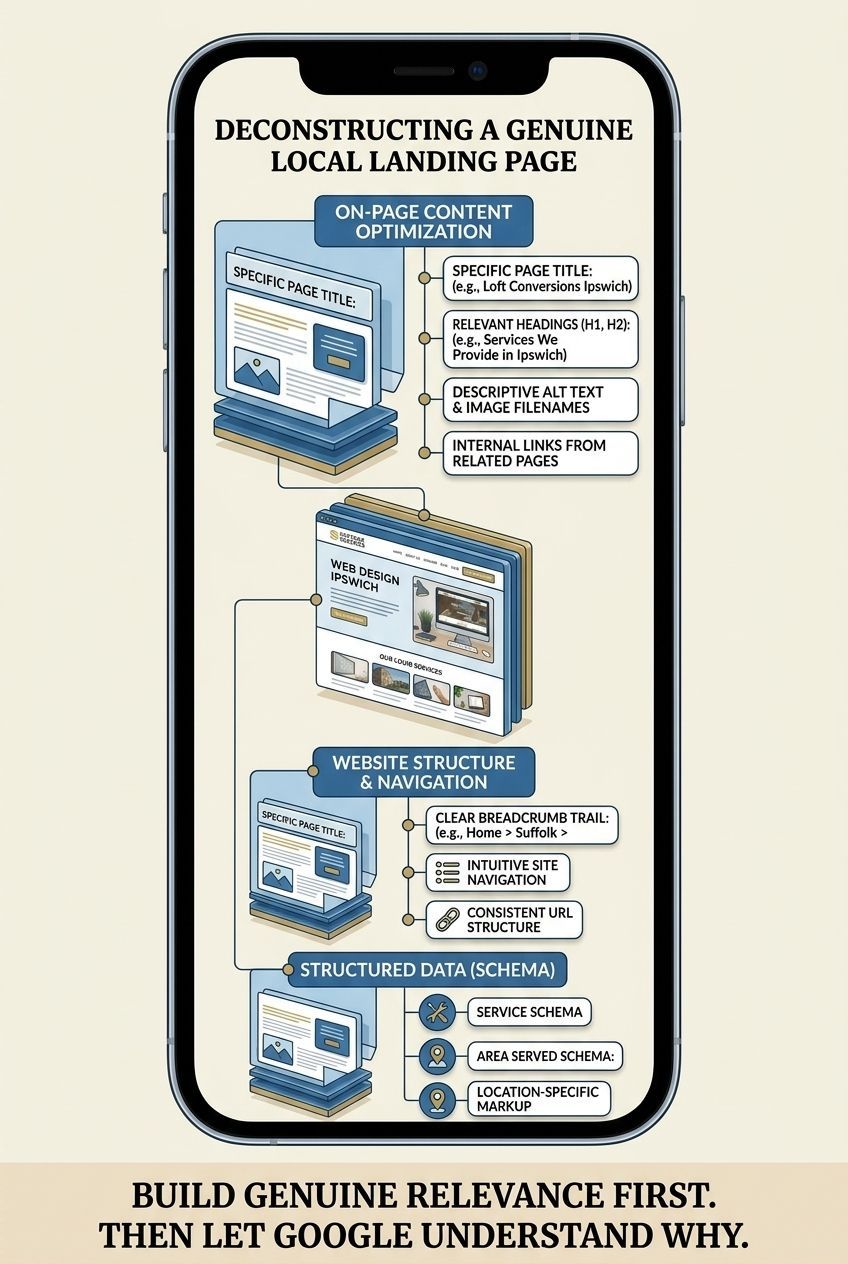
Depending on the page, that can include:
- a unique page title and meta description
- headings written specifically for the service and location
- internal links from relevant services, articles or location pages
- descriptive image filenames and alt text where the location is genuinely relevant
- appropriate structured data that accurately reflects the service and area covered
- a clear place within the website's navigation and breadcrumb structure
Schema markup can provide additional context too.
For example, relevant Service markup can describe the service being offered, while properties such as areaServed can identify the geographical area where that service is available when this accurately reflects the business.
But I wouldn't add Ipswich to every available field simply because the page targets Ipswich.
Structured data should describe the real page and business. It shouldn't be used to manufacture local relevance that the page itself doesn't demonstrate.
It's the same principle as the copy:
Make the page genuinely relevant first, then make it easy for search engines to understand why it is relevant.
For more on the technical side, see Schema Markup for Small Businesses.
Landing Pages Should Be Destinations, Not Bait
It's tempting to think of local landing pages as additional doors into your website.
But adding doors isn't much use if they all lead to essentially the same room.
A good landing page should be a destination in its own right. It should answer the question that brought someone there, demonstrate relevant experience and give the visitor a sensible next step.
Customer first. Useful page second. SEO supports both.
That's the distinction I would make between creating a page because another search term exists and creating one because another useful page should exist.
Google's Search Essentials provides the broader technical guidance, while my Small Business Website Checklist: 15 Things to Check covers many of the practical elements that help individual pages work as part of the wider website.
Need More Landing Pages, or Better Ones?
If you're considering adding new service or location pages to your website, don't start by asking how many you can create.
Start by working out which ones are actually worth creating.
I can help with that.
I research your services, customers, competitors and existing website to identify where additional pages could add genuine value, and where another page would simply duplicate what you already have.
The aim isn't to give your website the largest possible number of pages. It's to make sure the right customer can find the right page, get the information they need and know what to do next.
If you're unsure whether your website needs more landing pages, or simply better ones, get in touch and I'll take a look.