

Your SEO Might Be Showing Its Age
If keywords and backlinks come first, where does that leave the customer?
Where Is the Customer in All This?
SEO has changed enormously. Sometimes the way people talk about it hasn't.
I still hear familiar phrases:
“We need to find the best keywords.”
“We need to get that keyword onto the page more often.”
“We need to generate more backlinks.”
“We need another page targeting this search phrase.”
None of those things is automatically wrong. I research search terms. Good links can be valuable. Technical SEO matters.
But if keywords and backlinks are still the starting point and main strategy, I think the SEO is beginning to show its age.
Modern SEO should start somewhere else.
With the customer.

Start With What People Actually Want to Know
Suppose you install replacement windows.
You could start by researching phrases such as replacement windows Suffolk, double glazing Ipswich and dozens of variations, then build pages around them.
Or you could begin with what customers actually ask:
- How much will new windows cost?
- Which material should I choose?
- Will they reduce condensation?
- How long does installation take?
- Can you replace the glass without replacing the frames?
- Do I need planning permission?
- What guarantee will I get?
- Do you cover my area?
Answer those questions properly and you're creating something genuinely useful.
You're also naturally talking about windows, materials, installation, common problems, costs, your services, expertise and location.
Those questions can help you plan useful articles that support your service pages too. Your window replacement page might explain timescales, guarantees and the areas you cover. A separate guide could explain different causes of condensation and when changing the glazing might help. The two pages can link where it helps someone move from advice to a service.
In other words, looking after the customer hasn't stopped you doing SEO. It's helped you do better SEO.
Google Is Much Better at Understanding Meaning
Google isn't simply counting exact keywords on a page. Its SEO Starter Guide says its language systems can relate a page to searches even when it doesn't contain the exact terms. Its guidance for AI features says you don't need to capture every possible long-tail keyword variation.
That's why copy built around exact phrases often feels forced:
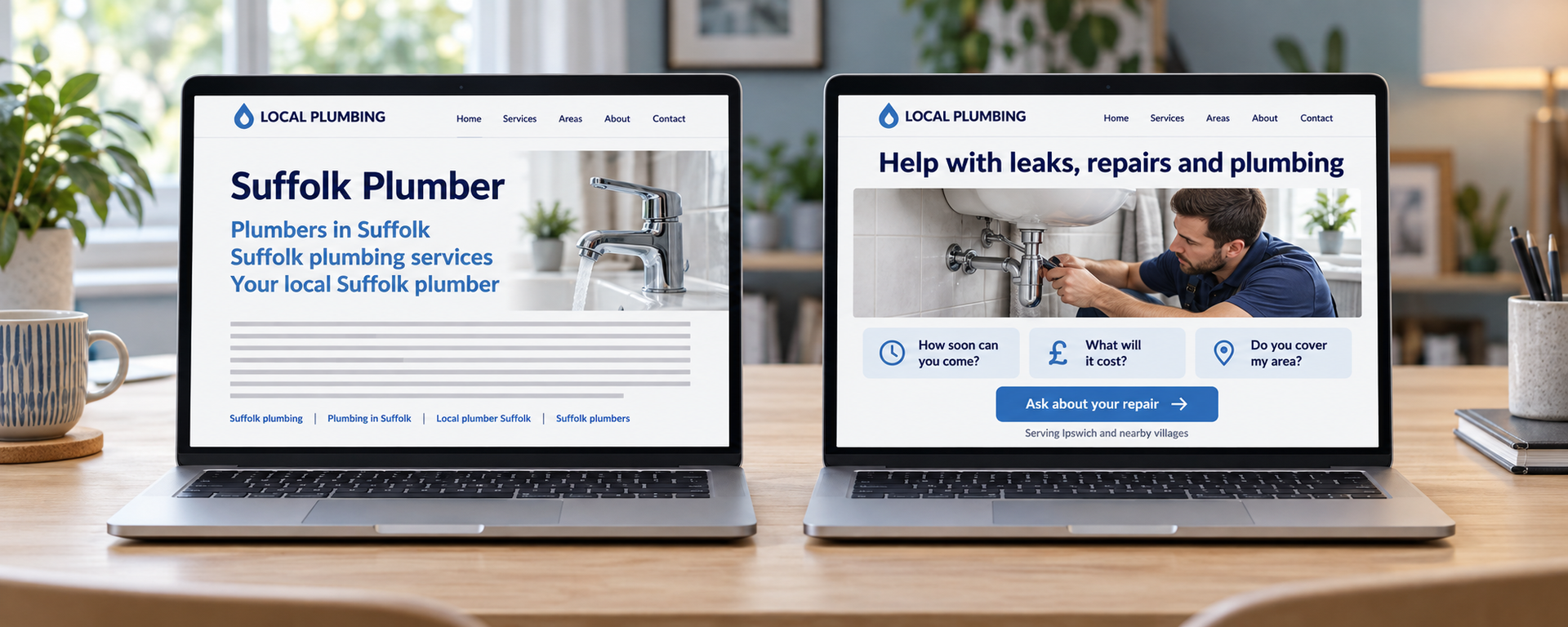
Looking for a Suffolk plumber? Our Suffolk plumbers provide plumbing services throughout Suffolk...
Slightly exagerated, but nobody talks like that.
Your customer shouldn't have to read like that either.
People-First SEO Is Still SEO
Google's guidance on helpful content asks whether a page offers original information, demonstrates experience and leaves the reader with enough knowledge to achieve their goal.
That is much closer to how I think a good business website should work anyway.
What does the customer need to know? What are they uncertain about? What questions keep coming up on the phone, in emails or while you're preparing quotations? What do you know from years of doing the job that your customer probably doesn't?
That's valuable website content. Naturally explaining what you do, where you work and the problems you solve also gives Google useful context without repeating the same location and service combinations throughout every page.
Keywords and Backlinks Aren't the Problem
I wouldn't stop researching keywords. Search data can reveal the language customers use and questions I hadn't considered.
The difference is what comes first. I don't want to find a keyword and then manufacture content to fit around it. I'd rather identify something customers need to understand, research it properly and then check that I'm describing it in language people use.
Backlinks are similar. A link from a manufacturer showing that you're an approved installer can help customers check your credentials. A link from a relevant trade organisation or local publication could be valuable too.
But “generating backlinks” for the sake of accumulating them is a different approach. Google's spam policies cover links created mainly to manipulate rankings, as well as keyword stuffing.
Technical SEO matters as well. Useful pages still need to be accessible and discoverable.
Is Your SEO Getting Left Behind?
This is the question I'd ask if I were choosing somebody to work on my website.
If most of the conversation is about keyword density, exact-match phrases, pages for every keyword variation and a target number of backlinks, I'd want to know what else they're doing.
- Where are the customers in the strategy?
- Where is the business's actual expertise?
- Where are the questions customers ask?
- Can someone move from a useful answer to the right service and then get in touch?
Google's systems will continue to change. Trying to second-guess every algorithm update isn't a strategy I'd want to build a business website around. Google's
stated aim is to prioritise helpful information created to benefit people. That isn't a promise of rankings, but it is a sounder starting point for a business website.

A Better Starting Point
Start with the customer. Answer their questions. Demonstrate what the business genuinely knows. Make services and locations clear. Connect related information properly. Then use keyword research, links, metadata, schema and technical SEO to support it.
Don't write something for Google and hope a customer likes it.
Write something genuinely useful for the customer, and make sure Google can find it and understand whom it's relevant to.
That's what I mean by modern, people-first SEO.
Is Your Website Still Using Old SEO Thinking?
If your website has been “SEO'd” but seems to be built around search terms rather than your customers, I can take a fresh look at it.
- Find out about Website & SEO Improvement
- See my
Researched & Optimised Guides & Articles service