
Why Is My Business Not Showing on Google? | SEO Guide
Understand why a business may be difficult to find in Google Search or Maps, how to identify the real problem and which improvements are most likely to help.

Having a website built, publishing it and then being unable to find it on Google is frustrating. It can feel as though Google has simply ignored your business.
Usually, the explanation is more specific.
You search for your business name and it appears. You search for the service you provide and it is nowhere to be seen.
Or perhaps the website appears in ordinary search results, but the business is missing from Google Maps.
These may feel like the same problem. They are not, and changing the wrong part of the website can waste considerable time without improving anything.
Google may not have discovered an important page. It may have crawled the page but decided not to index it. The page may be indexed but considered less relevant or useful than competing results. For a local search, the website may be sound while the Google Business Profile, location, reviews or wider business information remain weak or inconsistent.
The first task is therefore not to add more keywords or rebuild the website. It is to establish what is actually happening.
This guide explains how to diagnose the problem, which website and local-search factors matter, what can improve relatively quickly and why stronger visibility should be planned into a website rather than added as an afterthought.
Quick Answer
If your business is not showing on Google, first establish which situation applies:
- Google has not discovered the website or page.
- Google has discovered the page but has not indexed it.
- The page is indexed but ranks too low to be easily seen.
- The website appears for the business name but not its services.
- The website appears in ordinary results but the business is missing from Maps.
- The business appears in some locations but not others.
- A page that previously performed well has fallen.
- The website attracts visitors but does not generate suitable enquiries.
Do not begin by adding the same service phrase to the homepage several more times. A proper investigation considers the relevant page, website structure, technical settings, Google Search Console, Google Business Profile, competition and the information published elsewhere online.
The objective is not simply to appear somewhere on Google. It is to help the right potential customer find the right page, trust what they see and take a useful next step.
In This Article
- What Does “Not Showing on Google” Mean?
- Discovery, Crawling, Indexing and Ranking
- What Does Google Need to Understand?
- Does the Website Answer the Right Searches?
- Technical and On-Page SEO Foundations
- Why Knowing the Basics Is Not Enough
- Google Search Console and Sitemap Checks
- Page-Specific Schema Markup
- Google Business Profile and Local Visibility
- Helpful Supporting Content and AI Search
- How Long Can Improvement Take?
- Evidence From Completed Projects
- Why Rankings Cannot Be Guaranteed
- Practical Google Visibility Checklist
- Why SEO Should Be Planned Before the Build
- Frequently Asked Questions
1. What Does “Not Showing on Google” Mean?
Begin by searching for your exact business name.
If the website appears, Google probably knows that the business and website exist. Next, consider whether the website appears for one of its principal services combined with the town, county or normal service area, for example:
- electrician in Hadleigh;
- caravan storage near Ipswich;
- accountant in Sudbury; or
- website designer in Suffolk.
If the business appears for its name but not its services, the problem is unlikely to be basic discovery. It is more likely to involve the relevance and quality of the service page, competition or the evidence connecting the business with that service and location.
Ordinary website results and the local results displayed with a map must also be distinguished. The website and Google Business Profile can support one another, but they are separate parts of Google and will not always appear together.
Repeatedly searching for yourself is not a reliable measurement method. Results can vary according to wording, location, device and previous activity. Google Search Console provides stronger evidence about the searches for which a website is actually receiving impressions and clicks.
If This Is Happening, Start Here
| What you can see | What it may mean | What to check first |
|---|---|---|
| Nothing appears, even for the business name | Discovery, indexing or technical problem | Search Console URL Inspection, sitemap, robots and noindex settings |
| The business name works, but services do not | Relevance, competition or weak service pages | Page purpose, content, titles, headings and competing results |
| The website appears, but Maps does not | Google Business Profile or local-search issue | Verification, category, location, service area, reviews and accuracy |
| Impressions appear, but few people click | Weak position or unconvincing search result | Search query, page title, description and relevance |
| Visitors arrive, but few enquire | The problem may no longer be SEO | Clarity, trust, evidence, usability and contact routes |
| A previously visible page has fallen | Competition, website changes, technical issues or a search update | Search Console trends, recent changes, indexing and manual actions |
Scroll Across →
This diagnosis prevents unrelated changes being made merely because “SEO is not working.”
2. Discovery, Crawling, Indexing and Ranking
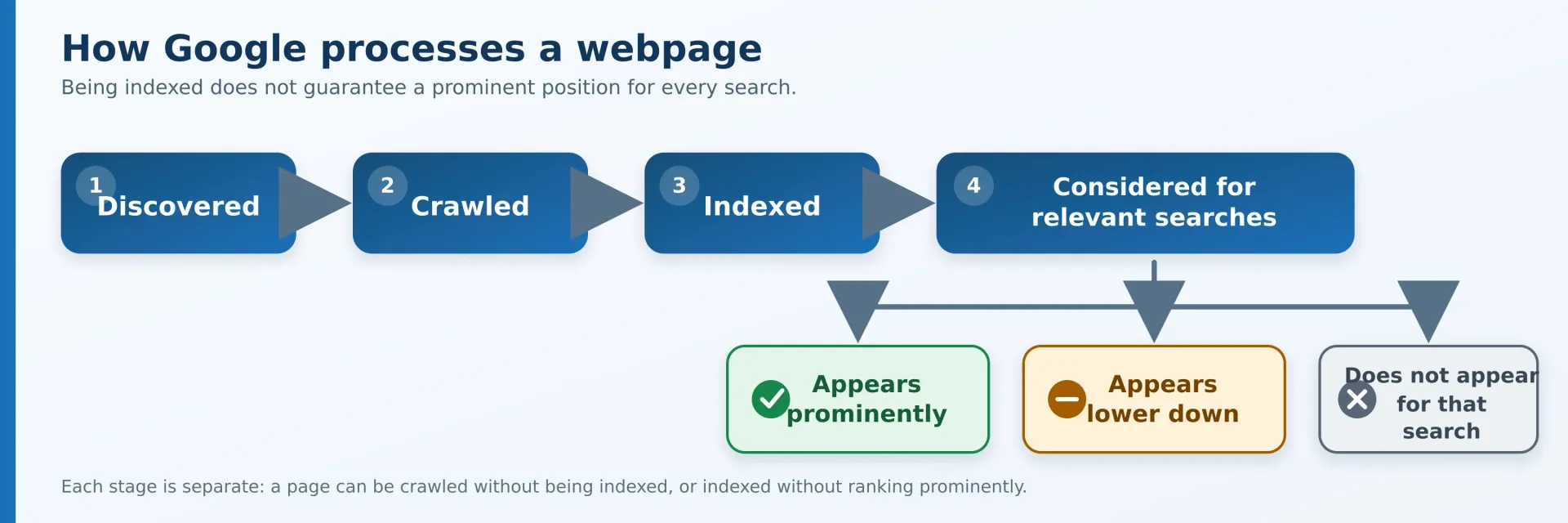
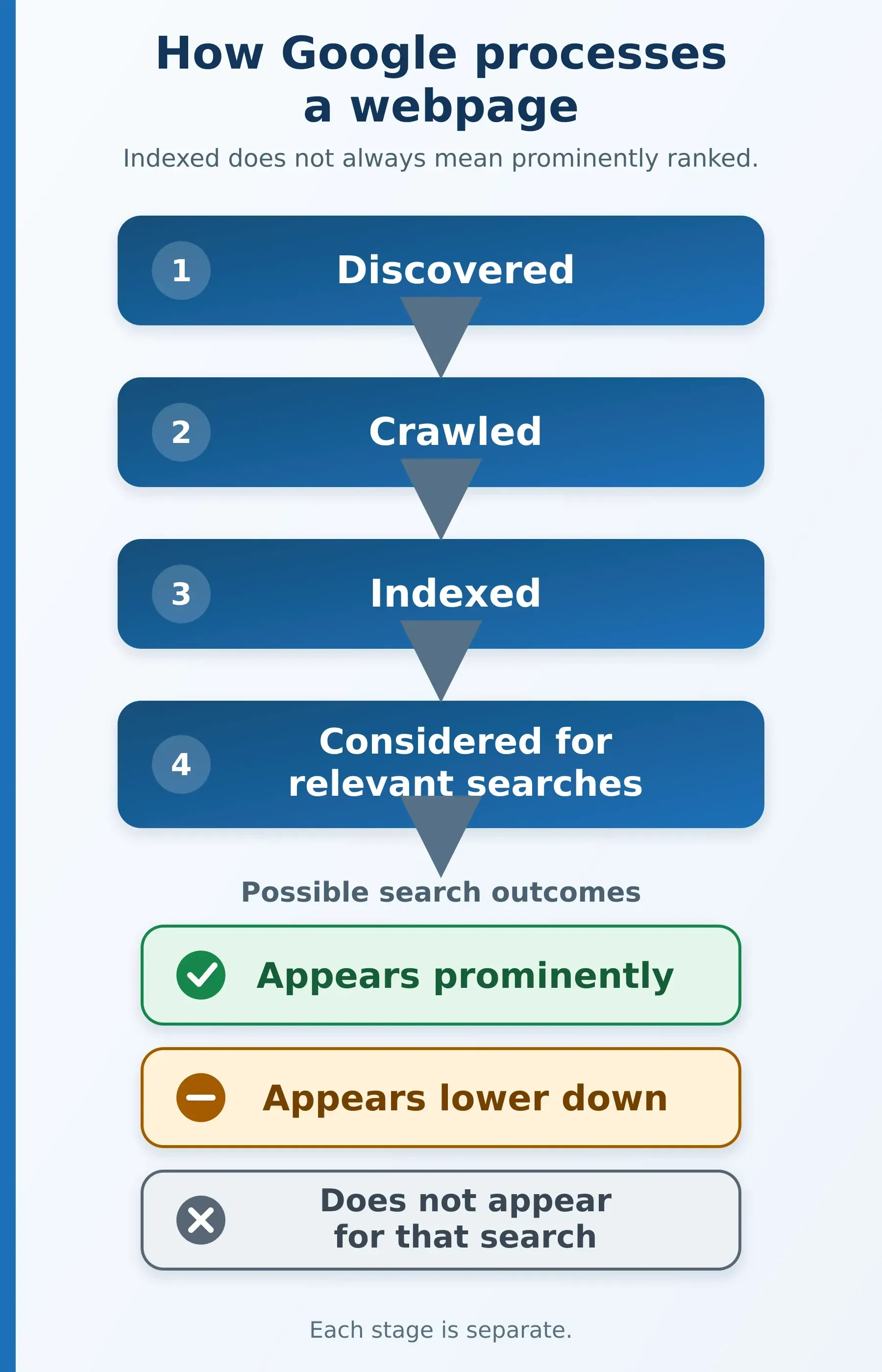
These terms are often used as though they mean the same thing. They describe different stages.
Discovery and crawling
Google first needs a route to the page. It may discover it through internal links, an XML sitemap, another website or a previous crawl.
Googlebot can then request and process the page. If important content is blocked, hidden behind a login, available only after an interaction or inaccessible through ordinary links, Google may struggle to retrieve it properly.
Indexing
After crawling, Google assesses the page and may add it to its index. An indexed page is eligible to appear in search; a crawled page is not automatically indexed.
Google may decide not to index a page if it contains a noindex instruction, appears duplicated, very similar to another page, technically unsuitable or insufficiently useful as a separate search result. Meeting Google’s basic technical requirements still does not guarantee indexing.
A sitemap helps Google discover important URLs but does not guarantee that they will be crawled or indexed. Google confirms this in its sitemap guidance.
Ranking and serving results
Once indexed, a page may be considered for relevant searches. Google then decides whether, where and in which form to show it.
That decision can change according to the words used, the searcher’s location, the type of result expected, competition and many other factors.
A page can therefore be:
- discovered but not crawled;
- crawled but not indexed;
- indexed but rarely shown;
- shown for the business name but not its services; or
- visible for one location or search but not another.
Google’s guide to how Search works explains these stages in greater detail.
3. What Does Google Need to Understand About Your Business?
Google cannot visit the premises, meet the team or watch the business complete a project. It can only interpret the information available to its systems.
That information should help establish:
- the genuine identity of the business;
- what it provides;
- where it is based and operates;
- which pages explain its principal services or products;
- who is responsible for the business and its content;
- what experience and specialist knowledge it can demonstrate; and
- whether other reliable sources support the same picture.
The website is central, but it does not work in isolation. Google may also encounter a Business Profile, reviews, directories, professional memberships, social profiles, independent mentions and links from other websites.
These sources do not need to repeat identical marketing text. They should, however, describe the same recognisable business without contradicting one another.
A useful test is whether a stranger could answer four questions after reviewing the website and important profiles:
- What does this business do?
- Where does it operate?
- Why should I believe its claims?
- What should I do next?
If those answers are unclear to a potential customer, Google is also being given an unnecessarily difficult picture to interpret.
4. Does the Website Answer the Right Searches?
A website cannot become relevant to a service simply by mentioning the service name several times.
Each important page should have a clear purpose and answer the needs behind the search.
Imagine a building company providing extensions, loft conversions, roofing, groundwork and property maintenance. If all five services are mentioned briefly on one page, Google receives limited information about each one. Potential customers receive a weak answer as well.
If somebody telephoned to ask about a loft conversion, the business would not simply say, “We do building work,” and end the call. It would explain the service, answer likely questions, discuss relevant experience and give the customer reasons to continue the conversation. The website should do the same.
The same applies to a plumber whose homepage briefly lists boiler servicing, leak repairs, bathroom installations and emergency callouts. These are different needs and may justify separate, properly developed pages.
A strong service page will normally explain:
- what the service includes;
- who it is for;
- where it is available;
- common options, questions or limitations;
- the business’s relevant experience;
- examples, photographs, reviews or other supporting evidence; and
- the appropriate next step.
The aim is not to create a page for every possible wording. It is to give each genuinely distinct service enough useful information to satisfy the person looking for it.
Balancing Attractive Design With Useful Information
An attractive website can still be difficult to find if its important information is limited, unclear or concentrated on one page.
The answer is not to choose SEO instead of good design. It is to combine professional presentation with clear service information, logical structure and sound implementation.
For a broader explanation, read A Good-Looking Website Isn’t Always a Good Business Website.
5. Technical and On-Page SEO Foundations
Useful information can still be undermined by poor implementation.
Important checks include:
- Indexing controls: Is the page accidentally set to
noindexor blocked from crawling? - Canonical information: Is Google being directed towards the correct preferred version?
- Status codes: Does the page return a normal
200response rather than an error or inappropriate redirect? - Internal links: Can visitors and search engines reach the page through ordinary crawlable links?
- XML sitemap: Does it contain the preferred public URLs rather than redirects, drafts or deleted pages?
- Titles and headings: Do they describe the real subject clearly?
- Mobile content: Is important information available and usable on a phone?
- Duplicate pages: Are several URLs competing to answer substantially the same question?
- Speed and stability: Does the page load and function reliably without preventing access to its main content?
- Security: Does the site use HTTPS without certificate or mixed-content problems?
Google’s Search Essentials separate technical requirements, spam policies and key best practices. They provide a useful foundation, but passing a checklist does not automatically make a page the best answer.
Not every technical mistake results in a formal Google penalty. More commonly, it prevents access, divides useful signals, removes existing value or leaves uncertainty about which page should be displayed.
6. Why Knowing the Basics Is Not Enough
Knowing that titles, headings, links, sitemaps and schema exist is not the same as knowing what should be changed, where it belongs or whether it addresses the real problem.
For example, creating ten location pages may sound like local SEO. If the pages contain almost identical text and the business has no meaningful relevance to those places, they may add little value.
Adding a large block of text to the homepage may increase the word count while making the page harder to use. Changing an established URL without a proper redirect may discard value that the old page had already developed.
Likewise, installing an SEO plugin does not plan the website, understand the business or decide which page should answer which search.
Effective improvement depends on diagnosis and judgement:
- Is the page absent from the index or merely ranking poorly?
- Is the intended search genuinely appropriate for that page?
- Is another page competing with it?
- Is the weakness technical, informational, local or reputational?
- Would improving the existing page be more sensible than creating another one?
- Is search visibility actually the problem, or are suitable visitors failing to enquire?
Knowing the ingredients does not automatically produce a good meal. The value lies in selecting the right ingredients and using them properly.
7. Google Search Console and Sitemap Checks
Google Search Console is one of the most useful tools for investigating visibility.
It can help establish:
- whether Google knows about a URL;
- whether the page is indexed;
- which version Google considers canonical;
- whether crawling or indexing problems have been reported;
- which searches generate impressions and clicks;
- whether performance changed after a particular date; and
- whether Google has reported a security issue or manual action.
URL Inspection should be used on the final public URL, not a preview or editing address. The live test can confirm whether Google can access the current page, while the indexed information reflects the version Google has processed.
An XML sitemap provides a list of the preferred URLs the website would like search engines to consider. It can help discovery, particularly on a new or substantially changed website, but it does not force Google to crawl, index or rank a page. Google explains this in its sitemap guidance.
Submitting a sitemap and requesting indexing are useful administrative steps. They are not substitutes for strong pages, crawlable links or a coherent website.
Search Console is the dashboard and diagnostic equipment. It can reveal symptoms and evidence, but it does not drive the website or guarantee the destination.
8. Page-Specific Schema Markup
Schema markup adds structured information that can help search engines identify what a page describes.
It is rather like labelling boxes in a storeroom. The labels do not improve what is inside, but they make the contents and purpose clearer.
Depending on the page, suitable markup may identify:
- an organisation or local business;
- a particular service or product;
- an article and its author;
- a person or team;
- a genuine location or service area;
- opening hours and contact information; or
- relationships between the page, service and provider.
Schema should describe information that is accurate and supported by the visible page. It should not be used to invent locations, exaggerate services or mark up reviews in a way that conflicts with Google’s policies.
Incorrect markup may prevent eligibility for a supported search feature. Misleading structured data can, in more serious circumstances, lead to a manual action affecting eligibility for rich results.
Schema does not make a weak page rank. It helps search systems interpret good information more explicitly.
See Google’s structured-data policies and my guide to schema markup for small businesses.
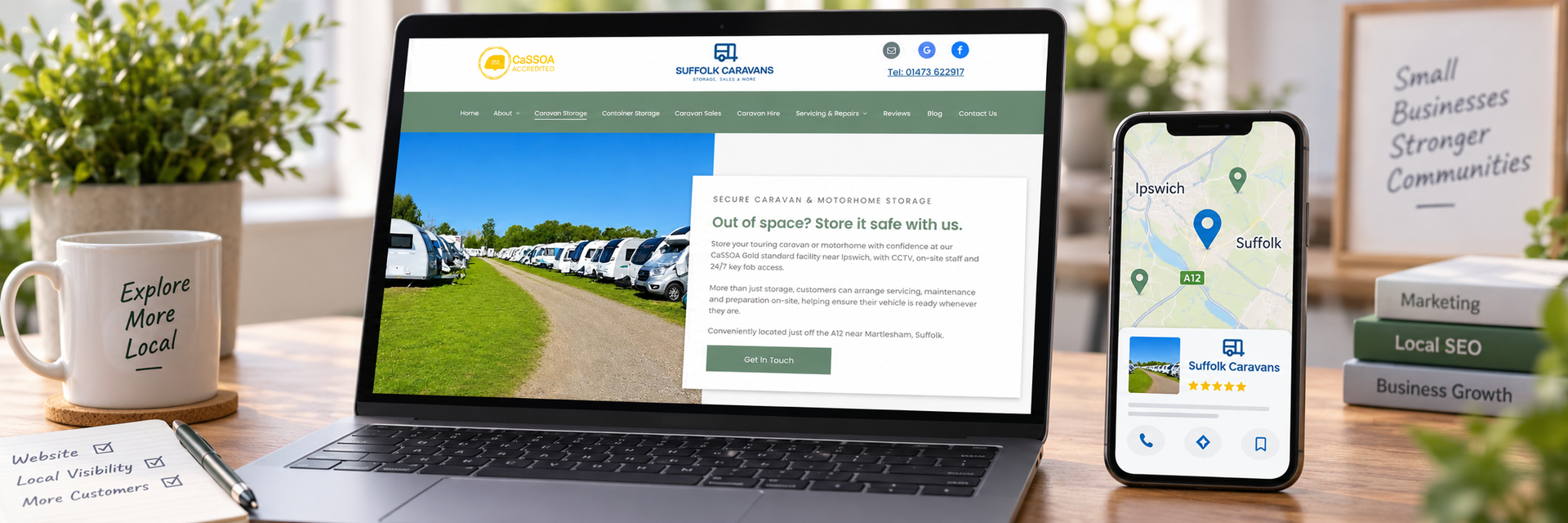
9. Google Business Profile and Local Search Visibility
For many local searches, Google displays a map and a selection of businesses separately from ordinary website results.
A website can appear in ordinary search while the associated business remains absent from those local results. Conversely, a Business Profile may appear even when the website is weak.
Google says local results are mainly based on:
- Relevance: how closely the business matches what the person is looking for;
- Distance: how far the business is from the location used in the search; and
- Prominence: how well known or established the business appears to be.
No legitimate technique can make a business physically closer to every searcher. Location therefore explains why two people can perform the same search and see different local results.
Important Business Profile checks include:
- Is the profile claimed and verified?
- Does the name reflect the real-world business name?
- Is the primary category the most accurate available choice?
- Is the address or service area configured correctly?
- Are the telephone number, website and opening hours current?
- Do the listed services reflect what the business genuinely provides?
- Are reviews genuine, recent and responded to appropriately?
- Does the linked website page support the same service and location information?
My guide to improving your Google Business Profile explains how to work through these checks and make the profile more helpful to customers.
Relevance and prominence can be supported through accurate profile information, useful service pages, genuine reviews, appropriate directories, links and wider recognition. Google provides further detail in its local-ranking guidance.
Every important platform should communicate the same accurate facts while directing potential customers towards the website for the most complete information.
10. Helpful Supporting Content and AI Search
Service pages usually speak to people who are reasonably close to making an enquiry. Helpful articles can reach them earlier by answering the questions surrounding a service.
A caravan-storage business, for example, might explain:
- how to prepare a caravan for storage;
- how to reduce the risk of damp;
- what CaSSOA accreditation means;
- which security measures insurers may expect;
- when the owner can access the caravan; and
- what to inspect before selecting a storage site.
Each article answers a genuine question, demonstrates relevant knowledge and creates another potential entrance to the website. It can then guide the reader towards the appropriate service without turning the advice into a hard sell.
This matters as search experiences evolve. A traditional search might ask for “caravan storage Suffolk.” A more conversational search might ask what to check before storing a caravan outdoors over winter and how to prevent damp or theft.
Google’s generative AI guidance confirms that established SEO practices remain relevant to AI Overviews and AI Mode. Pages still need to be crawlable, indexed, useful and properly connected. Google does not require secret AI markup, special text files or a separate form of schema.
AI features may explore several related questions when producing a response. That makes comprehensive, original and well-organised knowledge valuable, but it does not justify padding an article or producing generic “AI content.”
The search experience is changing, but the foundations remain the same.
Google currently includes AI Overviews and AI Mode activity within the overall Web data in Search Console rather than providing a separate dedicated AI-performance report. Search Console data should therefore be interpreted alongside analytics and genuine enquiries.
For a fuller explanation of useful supporting content, read How Helpful Blog Articles Build Trust, Authority and Search Visibility.
11. How Long Can Improvement Take?
There is no fixed timetable for SEO. Google must discover or revisit the relevant pages, process their information and decide when and where they may be useful.
What Can Happen Relatively Quickly?
- A corrected technical block may allow Google to access a page.
- A sitemap or internal link may help Google discover a URL.
- A new or changed page may be crawled and indexed within days or weeks.
- A website may begin appearing for its exact business name relatively quickly.
- Early impressions can reveal which searches Google associates with a page.
What Usually Takes Longer?
- Competing consistently for established local service searches;
- developing visibility across several products, services or locations;
- building a reliable body of reviews, links and independent recognition;
- strengthening authority through useful content and completed work; and
- generating a consistent flow of commercially valuable enquiries.
Indexing is not the same as ranking. A page can be indexed within 24 hours without appearing prominently for a competitive search.
Progress also depends on competition, location, website history, the existing reputation of the business and the quality of the available alternatives.
The article How Long Does SEO Take for a Small Business Website? examines these stages and expectations in greater detail.
12. Evidence From Completed Projects
SEO guidance is more useful when it is supported by real work rather than theory alone.
Suffolk Caravans: From No Online Presence to Genuine Enquiries
Suffolk Caravans began with no existing website, indexed pages or established search history.
The project included:
- researching the business, services and customers;
- planning separate pages around genuine services and search needs;
- writing the complete website content;
- preparing original images;
- implementing metadata, internal links and page-specific schema;
- creating and improving the Google Business Profile;
- publishing researched supporting guides;
- submitting the sitemap and important pages;
- and closely monitoring indexing and early search performance.
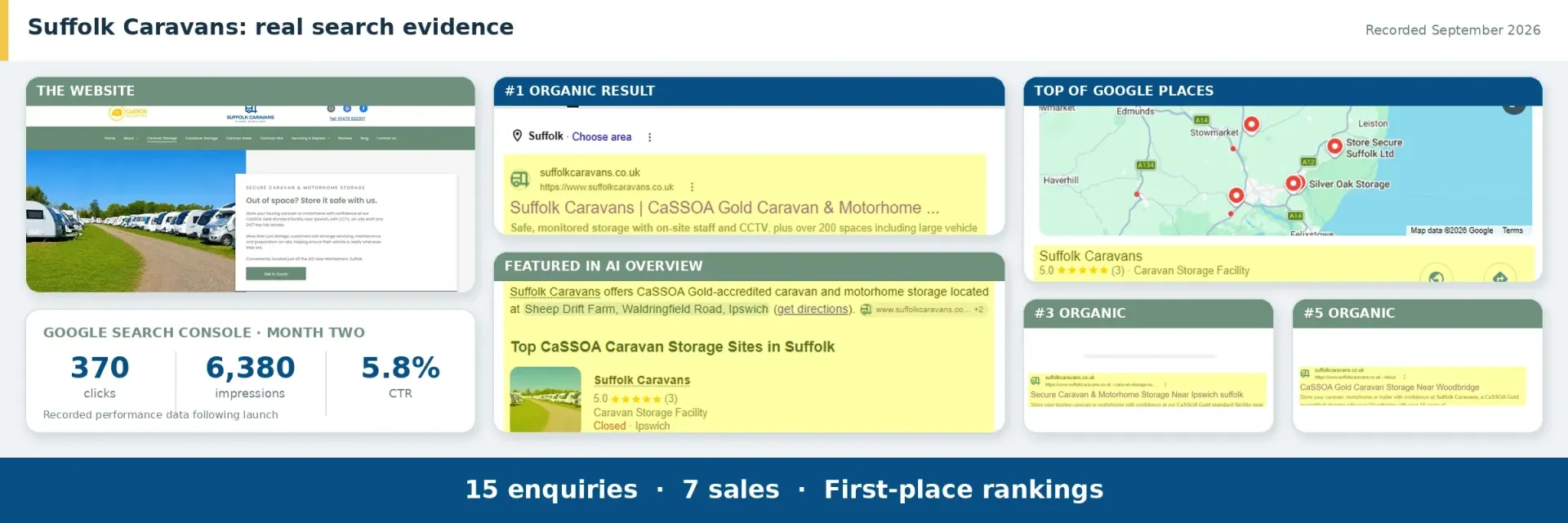
All public pages were indexed within 24 hours. The website began generating enquiries from its second week.
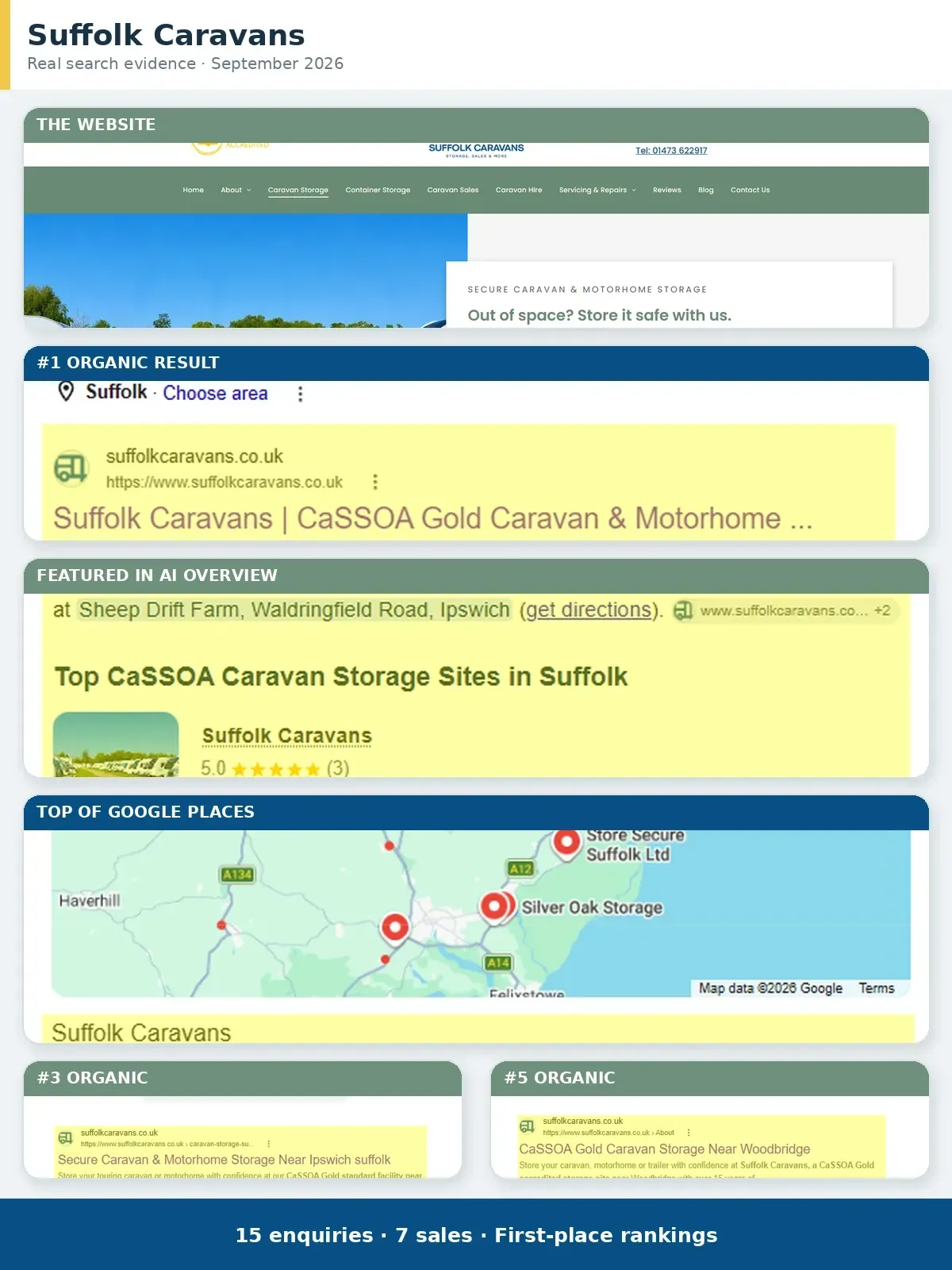
Within the first month, it generated 15 genuine website enquiries and contributed to seven storage sales.
It also achieved first-place Google rankings for relevant local searches, including CaSSOA-accredited and secure caravan storage around Ipswich and Suffolk. For several searches, multiple Suffolk Caravans pages appeared together on Google’s first page, including positions 1, 2 and 5 for CaSSOA storage searches and positions 1 and 3 for other important caravan-storage terms.
Website analytics and Google Search Console data from the second month showed that this was not simply a short-lived launch effect. Search visibility, website activity, visitor engagement and recorded contact actions all continued, demonstrating a sustained positive trend.
These results do not prove that every new website will progress at the same speed. They demonstrate what can happen when the business, website, content, technical implementation and wider online presence are planned together from the beginning.
Read the full Suffolk Caravans website and SEO case study.
Global Stage Engineering: Specialist UK and US Visibility
Global Stage Engineering serves a highly specialised market. Its website needed to explain technical products clearly while reaching customers beyond its immediate location.
Detailed product information, specialist terminology, supporting content and a logical website structure helped important pages achieve strong visibility, including top-three US positions observed for relevant stage-pulley and stage-block searches.
The two projects are very different. One is a local caravan business; the other supplies specialist engineering products internationally. That difference matters because an effective search strategy must reflect the real business rather than apply the same template to every website.
What These Examples Show
The objective is not a ranking for its own sake. The useful journey is:
Relevant search → visibility → click → useful page → trust → enquiry
A number-one position for the wrong search may produce no value. A smaller number of highly relevant local visitors can generate genuine business.
13. Why Rankings Cannot Be Guaranteed
No website designer or SEO consultant controls Google’s results.
Google decides what it crawls, indexes and displays. Competitors change their websites, new businesses appear, search behaviour develops and Google’s systems are continually refined.
It is possible to improve the factors within the business’s control:
- research and planning;
- page structure and content;
- technical accessibility;
- internal linking;
- metadata and structured data;
- Google Business Profile information;
- genuine reviews and wider references;
- useful supporting content; and
- monitoring and considered improvement.
It is not responsible to promise:
- a number-one position;
- a fixed ranking by a particular date;
- guaranteed indexing;
- a guaranteed volume of traffic or enquiries; or
- permanent visibility without further work.
Past results provide evidence of capability, not control over the next result.
Has Google Penalised the Website?
Most websites that lose visibility have not received a formal penalty.
Rankings may change because of competition, relevance, indexing decisions, technical problems, website alterations or changes to Google’s systems. A manual action is a specific enforcement measure applied when Google identifies a serious breach of its spam policies. Website owners can check the Manual Actions report in Search Console.
The response should follow the evidence. Do not assume a penalty merely because a page has moved down the results.
14. Practical Google Visibility Checklist
Work through these questions before making major changes.
Discovery and Indexing
- Can the website be found by its exact business name?
- Are the important public pages included in Search Console?
- Does URL Inspection show that the intended page is indexed?
- Is anything blocked by robots,
noindex, authentication or an incorrect canonical? - Does the XML sitemap contain the correct public URLs?
Page Relevance and Quality
- Does each important service have an appropriate page?
- Does that page properly answer what the potential customer needs?
- Are the title, main heading and visible content aligned?
- Is the location or service area clear without being forced repeatedly into the copy?
- Does the page demonstrate genuine experience, evidence and trust?
- Is another page competing for substantially the same search?
Technical Implementation
- Can Google access the same important content available to visitors?
- Do internal links provide a clear route to the page?
- Does it work properly on a mobile phone?
- Are redirects, canonical tags and status codes appropriate?
- Does structured data accurately match the visible content?
Local Visibility
- Is the Google Business Profile claimed and verified?
- Are its name, category, address or service area accurate?
- Are its telephone number, website and opening hours current?
- Does the website support the same service and location information?
- Are genuine reviews being requested and managed appropriately?
- Do important directories and profiles show current information?
Performance and Enquiries
- Which searches produce impressions and clicks?
- Are visitors reaching the correct page?
- Does the search result give them a reason to click?
- Does the page build enough confidence to continue?
- Are forms, telephone links and email routes working?
- Are genuine enquiries being measured rather than traffic alone?
One weakness will not always prevent a website from appearing. More often, several smaller problems combine to hold it back.
15. Why SEO Should Be Planned Before the Build
Many decisions affecting search visibility are made before a website is launched:
- which services need separate pages;
- what each page should explain;
- which search intent it should address;
- how navigation and internal links work;
- the page titles, headings and URLs;
- how locations and service areas are represented;
- how mobile content is presented;
- which structured data is appropriate; and
- how the website connects with the wider online presence.
Trying to add SEO after the website is complete can be like deciding where the plumbing and electrical sockets should go after fitting a new kitchen. Improvements remain possible, but earlier work may need to be undone or compromised.
This does not mean every underperforming website needs replacing. Some have sound foundations and need clearer content, improved page information or specific technical corrections.
Where the structure, navigation and content were created without considering visibility, however, a succession of isolated alterations may never produce a coherent result.
A successful website must work for customers, search systems and the business itself. It should be attractive, clear, technically accessible and commercially useful. None of those requirements should be treated as an afterthought.
16. Frequently Asked Questions
Why does my website appear for its name but not its services?
If your website appears for its exact business name but not for its services, Google probably knows the business exists but does not currently consider the relevant service page one of the strongest results for that search.
The page may need a clearer purpose, more useful service and location information, stronger internal links or better supporting evidence. The strength of competing pages will also affect where it appears.
Will requesting indexing improve my ranking?
No. Requesting indexing can alert Google to a new or changed URL, but it does not improve the page’s ranking or guarantee that it will be indexed.
Google still evaluates the page and decides whether and where to display it.
Can a business appear in Maps without a website?
Yes. An eligible and verified Google Business Profile can appear in local results without a website.
A useful website can nevertheless provide fuller service information, support relevance and give potential customers more evidence before they make contact.
Does schema markup improve rankings?
Schema is not a direct ranking shortcut.
It can help search systems understand what a page describes and may make eligible content available for certain supported search features.
The visible information and overall quality of the page remain fundamental.
Does an underperforming website always need rebuilding?
No. If the structure and platform are sound, focused improvements may be enough.
A rebuild becomes more reasonable when important limitations run through the navigation, page structure, technical setup and content.
How do I know whether SEO is working?
Use Search Console and Analytics to assess relevant impressions, clicks, landing pages and enquiries.
Progress should be judged by whether suitable potential customers are finding the website and taking useful action - not by one manually checked phrase.
Should I add FAQs if Google no longer shows FAQ rich results?
Yes, when the questions genuinely help the reader.
Google stopped displaying the FAQ rich-result feature in 2026, but that does not make useful questions and answers unnecessary.
FAQs should clarify real concerns, not exist merely to obtain a special search appearance.
Don’t Rebuild Your Website Until You Know What Is Wrong
An underperforming website does not always need replacing. It may need clearer service pages, improved content, stronger internal links, corrected technical settings or a better-connected online presence.
I can review the important pages, search visibility and underlying structure, then explain what appears to be holding the website back and which improvements should come first.
If the existing website has sound foundations, I will say so. If isolated changes are unlikely to solve the underlying problem, I will explain that clearly too.
Planning a New Business Website?
My principal service is researching, planning and building complete small-business websites. The design, page structure, written content, technical foundations and search visibility are considered together from the beginning.