
Your Website Isn’t There to Impress Web Designers
Good design matters — but clarity, trust and usefulness matter more.

Introduction
There is a strange thing that happens when people start planning a new website.
Very quickly, the conversation can turn to animations, colour palettes, fonts, clever effects and what other websites look like.
I understand why. You want your new website to look good. So do I.
But the person visiting it isn't there to admire your website. They've usually arrived because they need something.
A new front door. Somewhere secure to store their caravan. An electrician. A decorator. A specialist component they can't find anywhere else.
So before worrying about whether something should slide, fade or change colour when you hover over it, I think there is a much simpler question:
What does your customer actually need from this website?
Because ultimately, your website has a job to do.
Think Like Your Customer, Not a Web Designer
When I'm working on a website, I try to look at it from the customer's side of the screen.
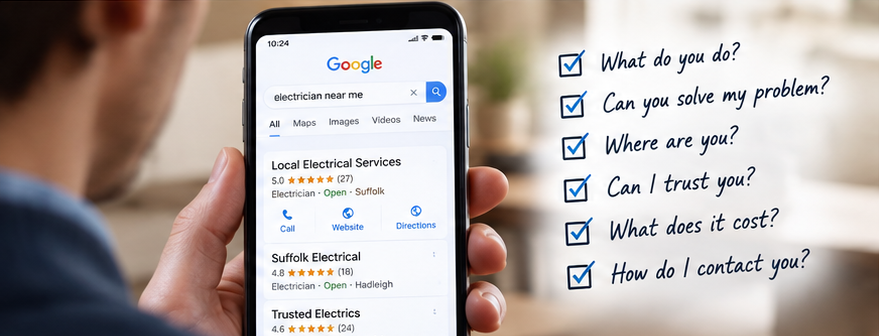
Imagine your consumer unit keeps tripping and you're looking for a local electrician.
You search Google, find a business and open its website. You're probably not particularly interested in whether the heading arrives with a clever animation.
You want to know whether they deal with domestic electrical faults. Whether they cover your area. Whether they appear experienced and trustworthy. How much it might cost. How soon they might be able to help. And how you can contact them.
Whatever the business, I think the questions are usually variations of the same six:
- What do you do?
- Can you solve my particular problem?
- Where are you — or do you cover my area?
- Can I trust you?
- What is this likely to cost?
- How do I contact you?
They are remarkably simple questions, yet I regularly see business websites that make answering them surprisingly difficult.
Where Are You?
For a local business, this can be one of the most important questions of all.
If I'm looking for a decorator, electrician, window company or somewhere to store my caravan, knowing what you do isn't enough. I also need to know whether you provide it where I am.
That shouldn't require detective work.
You don't need to mention every surrounding village twenty times or stuff place names into paragraphs where they don't belong. But your location and service area should be clear and natural.
It helps the customer establish very quickly:
“Yes, these people can actually help me.”
It also gives search engines clearer information about the geographical relationship between your business, its services and the people searching for them.
For a local business website, location isn't something I'd hide away on the contact page.
What About Price?
Not every business can put a fixed price next to everything it does. But there's often something useful you can say.
You might explain how your pricing works, what affects the final cost, whether you provide free quotations, a starting price or a typical range.
The purpose isn't necessarily to give somebody an exact figure.
It's to remove some of the uncertainty.
And that's really what a lot of good website content does.
Good Design Should Make Things Easier
I'm certainly not arguing for ugly websites.
Good design matters. It influences first impressions, credibility and how professional a business feels.
But I think some of the best website design almost goes unnoticed.
You naturally know where to look next. The headings make sense. The photographs contribute something. Important information appears where you expect it and, when you're ready to make contact, you don't have to hunt for a telephone number.
That's good design doing its job.
It's a little like walking into a well-organised shop. You probably don't stop to admire the position of every shelf and sign.
You simply find what you came for.
There might be a beautiful full-screen photograph and an impressive animated heading, but if I still don't know what the company actually does, something has gone wrong.
Or there might be five paragraphs about the company's passion, commitment and dedication before anybody explains the actual service.
These aren't really design problems.
They're communication problems.
Of Course, People Still Need to Find It
There is little point making a website easy to use if hardly anybody arrives there in the first place.
This is why I don't think web design and SEO should be treated as two completely separate jobs.
The words, headings, page structure, services, locations and subjects covered across a website all help search engines understand the business and when its pages might be relevant to somebody searching.
That doesn't mean stuffing pages with keywords.
It means creating useful pages around the things you genuinely do and answering the questions real customers genuinely ask.
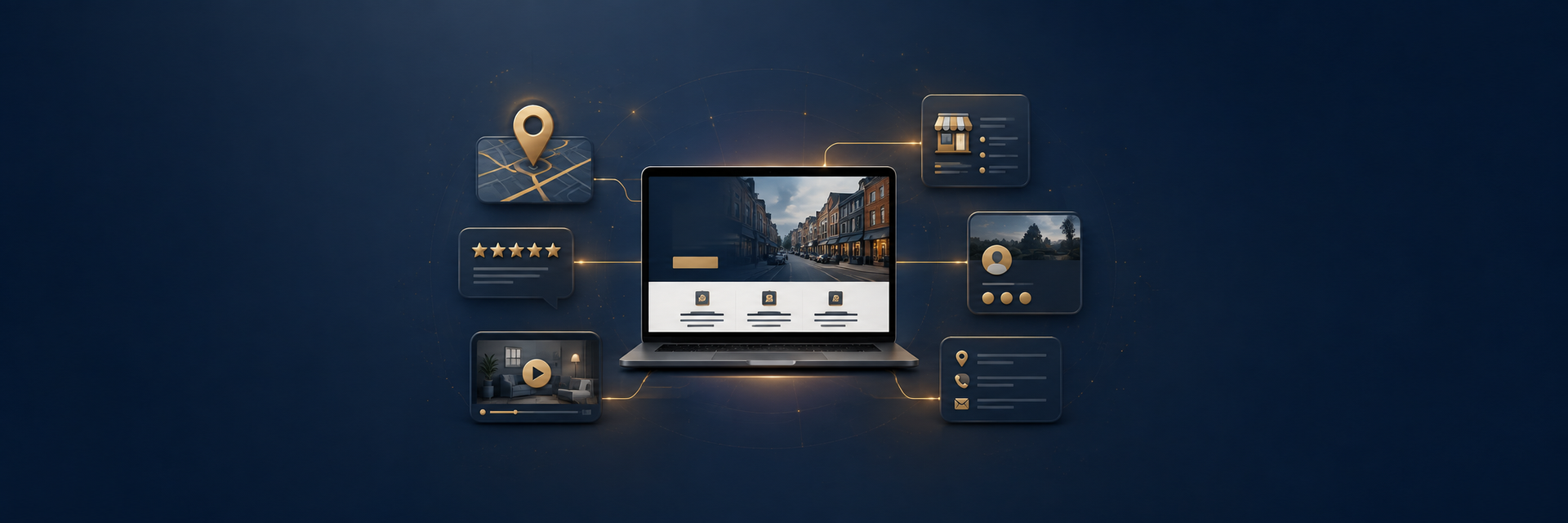
It's also why I increasingly think of the website as the central hub of a small business's online presence, rather than a digital brochure that gets built, published and forgotten.
Your Google Business Profile, reviews, useful articles, social content and other online references can help people discover and understand the business.
The website brings that picture together.
Sometimes the Best Improvement Is Removing Something
One of the harder parts of building a good small-business website is deciding what not to put on it.
Adding another section is easy. Knowing that it isn't helping is harder.
Does it answer something a customer genuinely wants to know? Explain a service? Provide evidence? Build trust? Remove a doubt? Help somebody take the next step?
If it doesn't do any of those things, I start questioning why it's taking up space.
A website isn't automatically improved by adding more information.
Sometimes the best improvement is removing the information that gets in the way.
The same goes for design effects. If movement genuinely improves the experience, great.
If it's moving mainly because we can make it move, I'm less convinced.
Summary
Your website doesn't need to impress another web designer.
It needs to work for your business and the people you want as customers.
They should be able to understand what you do, whether you can solve their problem, where you are or whether you cover their area, why they should trust you, what they might expect to pay and how to get in touch.
And ideally, they should be able to work most of that out without looking very hard.
Make the website easy to find and understand. Give people enough information and evidence to feel comfortable taking the next step.
It can still look fantastic.
It just needs to remember who it's actually for.
Because the best business website isn't necessarily the one somebody remembers for its clever design.
It's the one that makes the right person think: “Yes. These are the people I need to speak to.”
Want to Look at Your Website Differently?
If your website looks perfectly respectable but you're not convinced it's actually helping your business, I'm happy to have a look at it with you.
We can look at it from your customer's point of view: what they're searching for, what they find when they arrive, what questions remain unanswered and whether the website gives them a good reason to take the next step.
No jargon and no assumption that everything needs rebuilding. Sometimes relatively small changes can make a website much more useful.