
A Good-Looking Website Isn't Always a Good Business Website
A practical look at the SEO, content, structure and trust signals that help small business websites attract customers and generate enquiries.
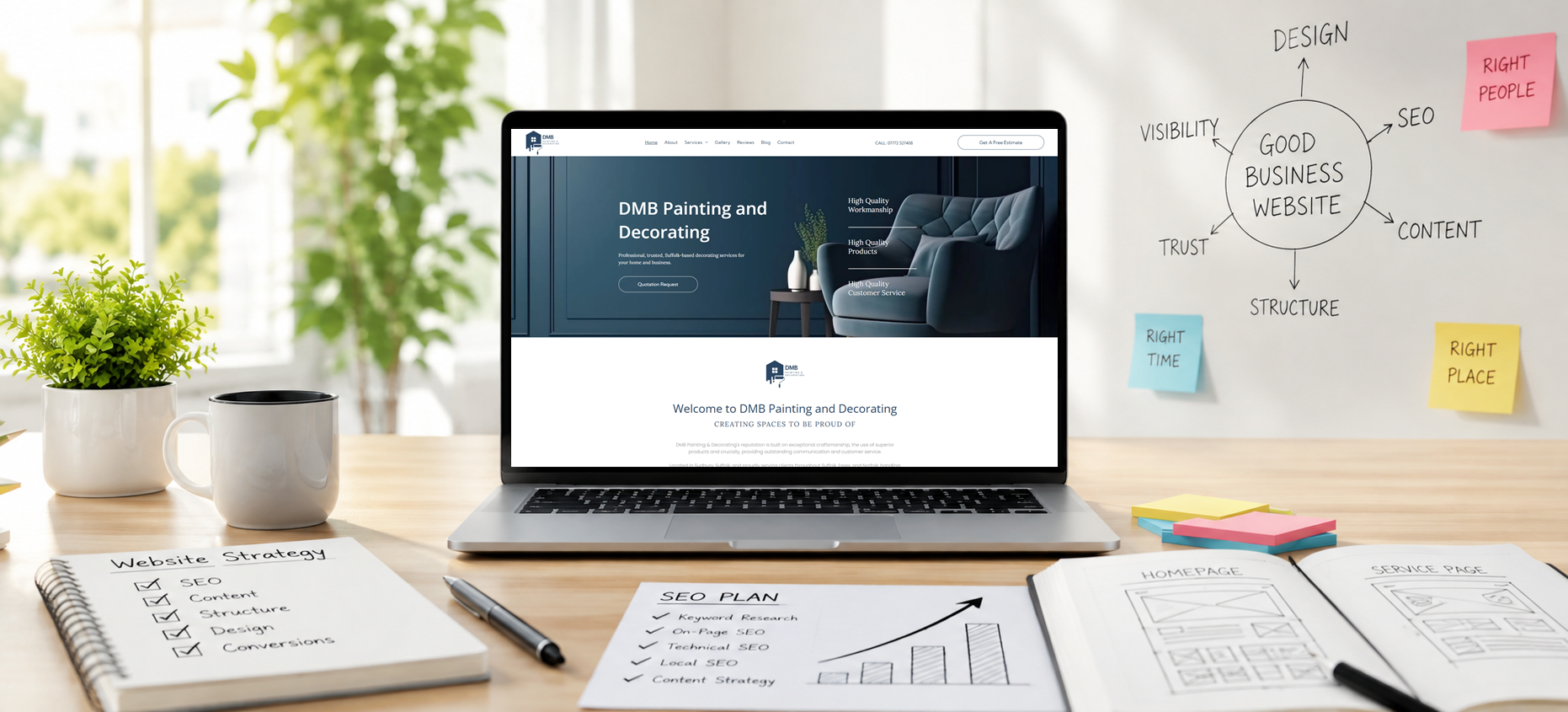
Why attractive design is only one part of creating a website that gets found by the right people, in the right place, when they actually need what you offer.
Quick Answer
A website can look fantastic and still achieve very little beyond being an online brochure.
If that is all you need, there is absolutely nothing wrong with it.
If you want people who have never heard of your business to find you when they search for a service, product, information, advice or help, you need something more.
Your website needs to help search engines understand what your business does, where you do it and which searches your pages are genuinely useful for. Good design needs to be backed by excellent information, intelligent website structure, sound technical implementation and, particularly for local businesses, a strong wider online presence.
In This Article
- What do you actually need your website to do?
- People don't always search for your company
- Looking good and being found are different jobs
- SEO needs to start before the website is finished
- How SEO has changed
- Modern SEO is about more than keywords
- Good information still needs good implementation
- More content isn't automatically better
- Your website is bigger than the home page
- Your wider online presence matters
- Helping Google understand your business
- Genuine expertise is difficult to copy
- Why this level of work costs more
- You have to understand the big picture
- Frequently Asked Questions
What do you actually need your website to do?
There are plenty of beautiful websites online.
Impressive photographs, clever animation, attractive colours and beautifully designed home pages.
Some are also extremely effective business websites.
Others are essentially online brochures.
That isn't necessarily a criticism.
If virtually all your work comes through recommendations and you simply need somewhere professional to send people who already know your name, an attractive brochure website may be exactly what you need.
The important thing is knowing what you are buying.
Expecting a brochure website to attract new customers through Google is rather like printing a beautiful company brochure, putting it in a drawer and wondering why nobody has called.
The brochure isn't necessarily the problem.
Distribution is.
A business website expected to generate opportunities needs to do more than look good when somebody arrives.
People have to find it in the first place.
People don't always search for your company
Existing customers may search for your business name.
Potential customers often can't.
They don't know you exist yet.
Instead, they search for whatever they need at that particular moment:
- a product or service;
- a problem they need solving;
- an answer to a question;
- advice before making a decision;
- a specialist in their area;
- a comparison between different options;
- or somewhere to buy something.
For a local business, geography makes this even more important.
Ten thousand website visitors from around the world may be practically worthless to a Suffolk tradesperson who works within 30 miles of home.
Twenty people nearby who need that exact service this week could be extremely valuable.
The objective isn't simply more traffic.
It is being found by the right people, in the right place, when they need something you can provide.
Different searches can mean very different things
This is where search intent becomes important.
Someone searching “Why is my roof leaking?” is probably looking for information.
Someone searching “Emergency roofer near me” may need somebody immediately.
Someone searching “ABC Roofing Ltd” already knows which business they are looking for.
All three searches concern roofing, but the person behind each one wants something different.
Those differences should influence where the searcher arrives. An informational search may be best answered by a helpful guide, an urgent local search by a clear service or location page, and a search for a particular company by its home page or Google Business Profile.
A good business website doesn’t expect one page to satisfy every type of intent. Different pages can meet different needs while still supporting the same business.
Google describes SEO in similar terms: helping search engines understand your content and helping users find your site through search.
Looking good and being found are different jobs
Appearance still matters enormously.
A poor website can damage the impression of an excellent business. Customers notice outdated information, weak photographs, confusing navigation and pages that are difficult to use.
A website should reflect the quality of the company behind it.
But Google doesn't rank websites because it likes the colour scheme.
Think of an excellent shop.
The premises are immaculate. The products are beautifully displayed. The staff are knowledgeable and the prices are competitive.
There is just one problem.
The shop is hidden where hardly anybody knows it exists.
Making the shop even prettier doesn't solve that problem.
You need to help the right customers find it.
That is one of the jobs of SEO.
If you built your own website, read why building it and getting it found are two different things.
Being found is only half the job
Getting somebody through the door doesn't guarantee a sale either.
A page can attract exactly the right visitor and still fail if the information is unclear, the business doesn't inspire confidence, the next step isn't obvious or getting in touch is unnecessarily difficult.
Search visibility gets the right person through the door.
The website then has to give them a reason to stay, trust you and take the next step.
That is why design, SEO and conversion shouldn't be treated as completely separate jobs.
They need to work together.

SEO needs to start before the website is finished
SEO is sometimes treated as something you add once the website has been designed.
Build the pages first.
Then “do the SEO.”
That is backwards if search visibility is an important objective.
Before building the website, it helps to understand what potential customers actually search for, which services matter most, how location affects those searches, what questions customers regularly ask and what information people need before choosing the business.
Those answers can affect the entire structure of the website.
Perhaps one broad Services page isn't enough.
Individual services may deserve detailed pages.
Customer questions may justify useful supporting articles.
Important subjects need to be connected logically.
The website structure should reflect both the way the business actually works and the way customers actually look for its services.
A real example shows how this works
A heating-products company I work with already had a professional website. It explained the business clearly and was intended mainly to build awareness and trust rather than generate direct online sales.
What it lacked was detailed information matching the questions people were actually asking.
They weren't simply searching for “heating products.” They were looking for help with specific problems:
- limescale building up in a hot water system;
- how to identify a faulty immersion element;
- why a cylinder wasn't heating properly;
- whether equipment could be repaired rather than replaced.
I created a connected series of articles addressing those questions properly. Each one explained the problem, helped readers understand possible causes and linked naturally to related information elsewhere on the website.
The impact was clear. Website activity increased significantly, and visitors arriving through one article often continued to other guides before exploring the company's main product pages.
They weren't simply landing on isolated blog posts. They were finding useful answers, recognising the company's expertise and continuing naturally through the website.
That was exactly what the company needed: helpful content that improved search visibility, demonstrated genuine knowledge and strengthened trust without turning the website into a hard-sell sales platform.
This example shows that effective improvements can still be made to an existing website. But trying to retrofit content, structure and SEO afterwards can often be like building a house and then deciding where the foundations should go.
How SEO has changed
Go back far enough and search engine optimisation could be remarkably crude.
Keyword stuffing was common. The same phrase might be repeated again and again because somebody wanted a search engine to associate the page with those words.
Some websites even hid keywords by putting white text on a white background.
That isn't an exaggerated example.
Google's spam policies specifically identify practices including keyword stuffing and hidden text, alongside other attempts to manipulate search rankings. Google Search Central: Spam Policies
As search engines improved, those techniques became increasingly ineffective or risky.
SEO also became considerably more sophisticated.
Good links can still be valuable.
Keywords haven't disappeared.
Technical SEO still matters.
But modern search systems are much better at relating language, subjects and searches without requiring every possible keyword variation to be repeated throughout a page.
That leads to a broader idea often described within the SEO industry as
semantic SEO.
Modern SEO is about more than keywords
Semantic SEO is essentially about helping search engines understand the meaning and relationships behind the words on a page, rather than treating individual keywords as isolated targets.
The terminology isn't particularly important.
The principle is.
A specialist business shouldn't need to repeat one keyword 27 times.
It should be able to explain the service properly, discuss related subjects, answer common questions, explain terminology, describe problems and solutions and demonstrate genuine knowledge of the subject.
A heating company, for example, might naturally discuss boilers, heating controls, radiators, faults, repairs, servicing, installation, efficiency and the questions customers ask before spending thousands of pounds.
You don't need to force those words onto a page.
You need to understand the subject well enough to explain it properly.
In simple terms:
Know your subject. Explain it properly. Make it useful.
Google's guidance encourages helpful, reliable, people-first content and asks website owners to consider originality, substantial coverage and whether content demonstrates first-hand expertise or depth of knowledge. Its spam policies separately address content and practices intended primarily to manipulate search rankings.
One of the most useful questions in Google's guidance is also one of the simplest:
Has the person reading the page learned enough to help them achieve their goal?
Google: Creating Helpful, Reliable, People-First Content
That sounds simple.
Doing it exceptionally well isn't.
Good information still needs good implementation
Having the right strategy is not enough if it is implemented badly.
There is a line from Beverly Hills Cop II that sums it up rather well:
“It was perfectly planned, but it was executed with Neolithic incompetence.”
It may be from a funny film, but it fits this situation perfectly.
The same can happen with a website.
Excellent information can be undermined by poor structure implementation:
- Useful pages can be difficult for search engines to discover.
- URLs can be changed unnecessarily.
- Pages can duplicate or compete with one another.
- Internal links can be missed.
- Important pages can even be prevented from appearing in search.
This is why SEO isn't simply a checklist.
Knowing that XML sitemaps, canonical URLs, redirects, indexing controls, internal links and structured data exist is not the same as knowing which are relevant, how they should be implemented or whether they are actually addressing the problem.
Structured data is a good example.
When appropriate and implemented correctly, it can give Google explicit information about content on a page and make certain content eligible for enhanced search features.
But Schema markup isn't a magic ranking button.
Adding structured data does not automatically make a page rank higher.
The important question is always:
What problem are we actually trying to solve?
Understanding an individual SEO technique isn't the same as understanding when, why and how to use it.
Knowing the recipe doesn't automatically make you a good chef.
More content isn't automatically better
“Publish more articles” isn't much of a strategy.
Why?
Another 100 pages don't automatically make a website 100 pages better.
If they don't answer genuine questions, demonstrate relevant knowledge or add something useful, they may simply create more pages without creating more value.
Google warns against producing large amounts of content primarily to manipulate search rankings. Its guidance also makes clear that there is no preferred Google word count that pages need to reach.
Ten excellent articles based on questions your real customers regularly ask could therefore be considerably more useful than hundreds of generic posts produced because somebody thinks websites constantly need “fresh content.”
The purpose of supporting content should be to
add knowledge, not simply add URLs.
Your website is bigger than the home page
The home page matters. But it isn't the whole website.
Someone looking for a particular service might enter through a service page.
Someone researching a problem could discover an article.
Someone else might first encounter your business through Google Maps, a review or another online reference.
A well-planned website gradually develops into a connected body of useful information:
- The home page explains the business broadly.
- Service pages provide depth.
- An About page can demonstrate the people and experience behind the company.
- Articles can answer questions, explore related subjects and support important services.
- Relevant internal links help users move naturally between that information and help search engines understand how the site's pages relate to one another.
One good page is useful.
A collection of strong, relevant and properly connected pages gives both the customer and the search engine far more information to work with.
Your wider online presence matters
Your website is important, but it doesn't exist in isolation.
Think of your online presence as a jigsaw.
Your website provides the deepest information and the content you control.
For a local business, an accurate Google Business Profile can be particularly important for discovery through Google Search and Maps.
Customer reviews provide social proof and insight into other people's experiences of the business.
Relevant directories, industry websites and legitimate third-party references can provide additional ways for people to discover and assess it.
LinkedIn and social media can introduce people to the company, its people and its work.
These elements have different jobs.
They do not all affect Google rankings in the same way.
But together they can influence how someone discovers a business, researches it and ultimately decides whether to trust it.
For local search specifically, Google says results are mainly based on relevance, distance and prominence. Complete and accurate business information can help Google understand and match a Business Profile to relevant searches, while factors including reviews and links can contribute to prominence.
Google: Tips to Improve Your Local Ranking
The objective isn't to manufacture an artificial online footprint.
It is to make the different parts of your online presence consistent with the genuine business that exists in the real world.

Helping Google understand your business
I sometimes describe the objective more simply as getting Google to “believe in your business.”
Obviously, Google doesn't literally believe anything.
What I mean is giving its systems enough useful and consistent information to understand what the business is, what it does, where it operates and which searches its pages may be relevant to.
Compare two companies.
The first has an attractive five-page website containing fairly generic claims about excellent service and customer satisfaction.
The second explains its services properly, answers genuine questions, demonstrates specialist knowledge, identifies the people and experience behind the company and provides useful information around the subjects in which it works.
Its business details are accurate.
Its Google Business Profile supports those details.
Its customers have left genuine reviews.
Other relevant sources may also reference the business.
Which gives both the potential customer and search engines more useful information to work with?
There is no magic number of pages, articles, reviews or links that suddenly makes Google decide a website should rank first.
There is no switch to flick.
What you can do is build a clearer, more useful and better-supported representation of the real business.
Piece by piece, the picture becomes easier to understand.
Genuine expertise is difficult to copy
This is where genuinely good businesses have a significant advantage.
A competitor can copy the basic structure of a website:
- They can use similar colours.
- They can target similar searches.
- AI can now produce enormous quantities of plausible-looking text.
What is much harder to reproduce is genuine experience:
- Your people.
- Your specialist knowledge.
- Your completed work.
- Your understanding of customers.
- The unusual questions you have been asked.
- The problems you know how to solve.
- The details somebody only learns after working within an industry for years.
Google's people-first guidance encourages content that demonstrates first-hand expertise and depth of knowledge.
But the bigger advantage isn't simply what Google may or may not recognise.
It is that a real business has something genuinely useful to say.
A heating engineer has encountered problems that a generic writer hasn't.
A builder knows which mistakes cost customers money.
A manufacturer understands its products in ways that cannot simply be invented from a few search results.
A specialist business knows the questions customers ask, the misconceptions they have and the details that matter when something goes wrong.
That knowledge is valuable.
The skill lies in extracting it, researching where necessary, organising it properly and turning it into accurate, useful information that customers can understand.
The website then has to present that information correctly.
You need genuine skills on both sides.
Why this level of work costs more
Two websites can look remarkably similar on a laptop while representing completely different amounts of work.
One may involve designing five attractive pages using information supplied by the customer.
Another may involve:
- understanding the business;
- researching its customers and market;
- investigating relevant searches;
- planning the website structure;
- writing original content;
- preparing and optimising images;
- creating titles and metadata;
- implementing technical SEO;
- developing internal links;
- configuring Google Search Console;
- considering Google Business Profile and local visibility;
- and producing useful supporting content.
Most of that work isn't immediately obvious when comparing two home pages.
But somebody has to do it.
And genuine expertise takes time.
That doesn't mean the most expensive website is automatically the best, any more than the cheapest is automatically poor.
It means businesses should understand what they are paying for and what they expect the website to achieve.
If you need an attractive online brochure, buy a good online brochure.
If you expect your website and wider online presence to help generate business, expect to pay for the research, expertise, content and technical work required to give it the best opportunity to do that.
You have to understand the big picture
Modern SEO isn't one clever technique.
It isn't a plugin.
It isn't putting keywords into headings.
It isn't following a generic checklist.
And it certainly isn't getting a green light from an SEO tool and assuming the job is finished.
It is understanding how design, website structure, technical implementation, useful information, internal links, business expertise, local business information, reviews and the wider online presence fit together - while recognising that each plays a different role.
Individual pages still need to be excellent.
But you also need to understand what each page contributes to the website as a whole.
Over time, the picture becomes clearer.
The evidence becomes stronger.
The website becomes more useful.
And search engines have far more information with which to understand what the business does, where it does it and when one of its pages may be a useful answer to somebody's search.
You have to understand the big picture - because Google does.
Planning a New Business Website?
If you are planning a new website or considering improvements to an existing one, I am always happy to have an informal conversation about what would be useful.
You do not need a detailed brief, a few notes about your business are usually enough to begin.
Frequently Asked Questions
What makes a good small business website?
A good small business website makes it immediately clear what the business does, who it helps, where it operates and what the visitor should do next.
It should be easy to navigate, fast, mobile-friendly, trustworthy and filled with useful information that customers need and search engines can understand.
Does web design affect SEO?
Yes. Web design can affect SEO through website structure, navigation, mobile usability, page speed, headings, internal links and how easily search engines can access and understand the content.
Visual appearance alone will not make a page rank, but poor design or implementation can make excellent information harder for both customers and search engines to find and use.
Google: Understanding Page Experience
Why is my business website not showing on Google?
A business website may not appear because Google has not discovered or indexed it, technical settings are blocking it or its pages are not yet considered sufficiently relevant and competitive for the search.
Not being indexed is different from being indexed but ranking poorly.
Google Search Console can show whether a page is indexed, which searches generate impressions and whether technical problems require attention.
Further reading on why your website isn't showing on Google.
Google: Get Started with Search Console
How many pages should a small business website have?
There is no ideal number of pages for a small business website.
It needs enough well-planned pages to explain the business, cover its distinct products or services, answer important customer questions, provide credible evidence and offer clear contact routes.
Five useful pages can outperform twenty thin or repetitive ones.
Does a small business website need a blog?
No. A blog is not essential for every small business and publishing articles does not automatically improve rankings.
Articles become valuable when they answer genuine customer questions, demonstrate relevant expertise and support the business’s important products or services.
A small collection of excellent articles is usually more useful than frequent generic posts.
How long does SEO take to work?
SEO has no fixed timescale.
Google may discover and index a page quickly, but achieving useful and consistent search visibility usually takes longer.
For planning purposes, the first few weeks may bring discovery and early movement, around three months can provide a better indication of meaningful progress, and broader authority may take six to twelve months.
These are benchmarks, not guarantees as there are so many variables.
Following Google’s guidance and resolving technical problems can give a website a stronger start, but faster results cannot be guaranteed.
For a more detailed explanation, see how long SEO can take for a small business.
Can SEO be added to an existing website?
Yes. An existing website can often be improved through better content, clearer page structure, stronger internal linking, corrected technical problems, improved metadata and more accurate indexing signals.
However, retrofitting SEO may require substantial changes if the website was originally built without considering customer searches, page purposes or how its information should fit together.
What should I ask before paying for a new website?
Don't only ask “What will it look like?” or “How many pages do I get?”
1. Will I work directly with the person creating my website?
You work directly with me. I personally research, plan, write, design and optimise the website, keeping the entire project joined up.
2. How will you understand my business and customers?
I learn how the business works, what makes it different and what its customers need. Where useful, I also visit the business and see its work first-hand.
3. Who will provide the content and images?
My complete service includes professional copy and carefully prepared images. A conversation and a few jotted notes are normally enough to get started.
4. Is SEO included from the beginning?
Yes. Search intent, services, locations and customer questions shape the structure, content, metadata, internal links, technical SEO and structured data.
5. What happens when the website goes live?
Depending on the project, launch work can include Search Console, sitemap submission, indexing checks, Google Business Profile improvements and wider online visibility.
6. How will we know whether it is working?
I use Search Console, analytics and enquiry tracking to assess relevant visibility, website activity and genuine business opportunities.
These questions reveal whether you are buying an attractive website or a properly researched, written and optimised business website.
Useful Google Resources
The following Google resources support many of the principles discussed in this article: