
How Helpful Blog Articles Build Trust, Authority and Search Visibility
Helpful, well-researched content that builds trust, strengthens your website and supports search visibility.

A good small-business website should quickly explain what the business does, who it helps and why someone should make contact. It should also look professional and be easy to use.
The challenge is that customers, and search engines, sometimes need far more information than can comfortably fit on a service page. Helpful articles give that depth somewhere to live, allowing the main pages to remain concise, attractive and focused on action.
The difficult part is not simply writing more words. It is deciding what information belongs where, what the reader really needs, how different pages should connect and how to provide enough depth for search engines without spoiling the experience for people.
In this guide
- Quick answer — The main benefits at a glance.
- What makes an article genuinely useful? — Start with a real customer need.
- The helpful shopkeeper effect — How useful advice builds familiarity and trust.
- This is an overview - the devil is in the detail — Why execution matters as much as the idea.
- How helpful articles can support Google visibility — Help people first while improving search understanding.
- What topical authority actually means — Build authority through connected evidence.
- Semantic SEO without ruining the reading experience — Balance useful depth with clarity.
- Connected content and internal linking — Give every page a distinct purpose.
- How I create a genuinely authoritative article — From research and planning to monitoring.
- One article can support the wider business — Reuse valuable research across multiple channels.
- How to know whether it is working — Measure visibility, engagement and commercial value.
- The aim is to publish something worth finding — Create lasting value rather than more content.
Quick answer
A genuinely useful article can:
- answer a question a potential customer is already asking;
- demonstrate real knowledge and experience;
- build familiarity and trust before a sales conversation;
- help search engines understand the business and its specialist subjects;
- support related service and product pages;
- keep important website pages shorter and easier to use; and
- provide useful material for social media, email and customer support.
The purpose is not to fill a blog or repeat a keyword. The reader should leave better informed, more confident or able to make a safer decision.
What makes an article genuinely useful?
A helpful article begins with a real need, not a publishing schedule. The reader may be trying to solve a problem, understand a technical subject, compare two options or avoid an expensive mistake.
The subject should have a clear purpose and the answer should be complete enough to satisfy it. Depending on the topic, this may require:
- a short answer near the beginning;
- practical steps in a sensible order;
- plain-English explanations of technical terms;
- photographs, examples, diagrams or reliable sources;
- important limitations or exceptions; and
- a clear explanation of when specialist help is required.
Length is not a measure of quality. A focused 800-word answer can be more useful than 2,000 words of repetition, while a complicated subject should not be cut short to meet an arbitrary target. Google says there is no preferred word count used by its ranking systems.
A valuable test is:
Would this article still help someone who never becomes a customer?
If the answer is yes, it has probably been created for the right reason. It can still contain an appropriate call to action, but the help should not be conditional on the reader buying something.

The helpful shopkeeper effect
Imagine taking a broken fitting into a local hardware shop. The owner examines it, explains what went wrong and shows you how to repair it. They may even tell you that you do not need to buy anything.
Months later, when you need tools, materials or further advice, which shop are you most likely to remember?
Probably the one that helped when there was nothing immediate to gain.
A useful article can create the same response. The business demonstrates its value before asking the reader to become a customer. The reader may not consciously feel indebted, but the company becomes more familiar, generous and trustworthy in their mind.
If professional help is later required, choosing that business feels safer and more natural. It is no longer an unknown company making claims about itself; it is the company that has already been useful.
This is related to the human principle of reciprocity, but it should never be treated as a psychological trick. Thin advice followed by repeated sales messages is unlikely to create goodwill. The information must genuinely help, even when the reader chooses to do the work themselves or use another supplier.
This is an overview - the devil is in the detail
The principles sound straightforward: find a useful subject, research it, write clearly and optimise the page. Applying them successfully is much harder.
Writing the sentences is only one part of the job. The creator must understand the business, reader, search intent, wider website and required evidence. They must know what to include, what deserves a separate page and where a link is more helpful than another five paragraphs.
Accuracy matters. So do structure, originality, tone, page design, images, headings, metadata, internal links and technical implementation. All of these decisions interact.
Done exceptionally well, an article can earn strong search visibility and continue helping people for years. Done badly, it may achieve nothing. Inaccurate advice can damage trust, while pages covering the same intent can compete with one another.
Keyword stuffing, misleading structured data or scaled low-value content created to manipulate rankings can breach Google's spam policies. This can lead to demotion or a manual action affecting pages and potentially a broader part of the site.
Not every loss of visibility is a penalty. Often a page is simply less useful, less relevant or less credible than competing results. Even excellent work cannot guarantee a ranking. The point is that careful execution gives both customers and search engines clearer, more useful information about the business.
How helpful articles can support Google visibility
Google says its ranking systems are designed to prioritise helpful, reliable, people-first information. Google's guidance encourages original, substantial, accurate and well-produced content that demonstrates appropriate first-hand experience or expertise.
One good article does not automatically lift an entire website, and there is no simple “trust” or “topical authority” score. Google uses many systems and signals; competition, reputation, links, technical quality and intent can all influence results.
The practical value of a strong article is that it gives Google and other search engines something meaningful to understand. It can:
- answer a specific search need more completely than a service page;
- use the language, entities and related concepts that naturally belong to the subject;
- demonstrate first-hand experience through original photographs, processes, examples and observations;
- cite sources and clarify who created or reviewed it;
- connect logically with related pages; and
- earn attention or links because it is worth using or sharing.
The article must also be discoverable and technically sound. A brilliant guide hidden from search engines, isolated from the website or poor on mobile has been let down by its implementation.
This is why useful content and SEO should not be treated as opposites. Google describes SEO as helping search engines understand content and helping people decide whether to visit it. Good optimisation supports people-first information; it does not replace it.
I have also seen these principles work in practice. For examples of how carefully planned content and website structure have supported early search visibility, read
Why Is My Business Not Showing
on Google?
Semantic SEO without ruining the reading experience
Semantic SEO means covering the meaning, context and necessary detail of a subject rather than repeatedly inserting one exact keyword.
An article about secure caravan storage might naturally discuss CCTV, controlled access, perimeter protection, insurance conditions, CaSSOA accreditation and long-term preparation. These are not phrases to force into the copy; they are related parts of the reader's decision.
This creates a constant balance. Search engines need enough information and context to understand the page. Readers usually want the clearest answer in the shortest reasonable time.
Too little detail is vague. Too much poorly organised detail buries the answer. A technically complete article can still fail if it feels like a wall of text.
The solution is layered information:
- provide the direct answer near the beginning;
- use descriptive headings that help people scan;
- keep paragraphs short and explain unfamiliar language;
- use lists, tables, diagrams and photographs where they improve understanding;
- place greater detail further down the page; and
- link to a separate guide when a related subject deserves a complete explanation of its own.
Think of a specialist shop. It may contain hundreds of products and years of knowledge, but everything is not piled in the doorway. The entrance is clear and specialist help remains available.
The objective is not the maximum amount of information. It is the maximum
useful information, organised in the most appropriate place.
Connected content and internal linking
A website works best when each page has a clear job.
A main guide can introduce a broad subject. Supporting articles can answer narrower questions. Service pages can explain the commercial offer and make it easy to enquire. Case studies can provide evidence of results.
This is often described as a pillar-and-cluster structure:
Main guide → focused supporting articles → relevant service pages → appropriate next action
The direction is not one-way. Service pages can link to guidance, supporting articles to the main guide, and related articles to a genuinely useful next subject.
Internal links let people continue their research and help search engines discover content and understand relationships. Descriptive anchor text such as “choosing a secure caravan storage site” is more useful than “click here”.
Every connected page should still have a distinct purpose. If two articles answer essentially the same question, they may confuse readers and compete for similar searches. The answer is not to add more links; it is to decide whether the pages should be differentiated, consolidated or redirected.
This is where content planning becomes website architecture. For more on the website itself, read
A good looking website isn't always a good business website.
How I create a genuinely authoritative article
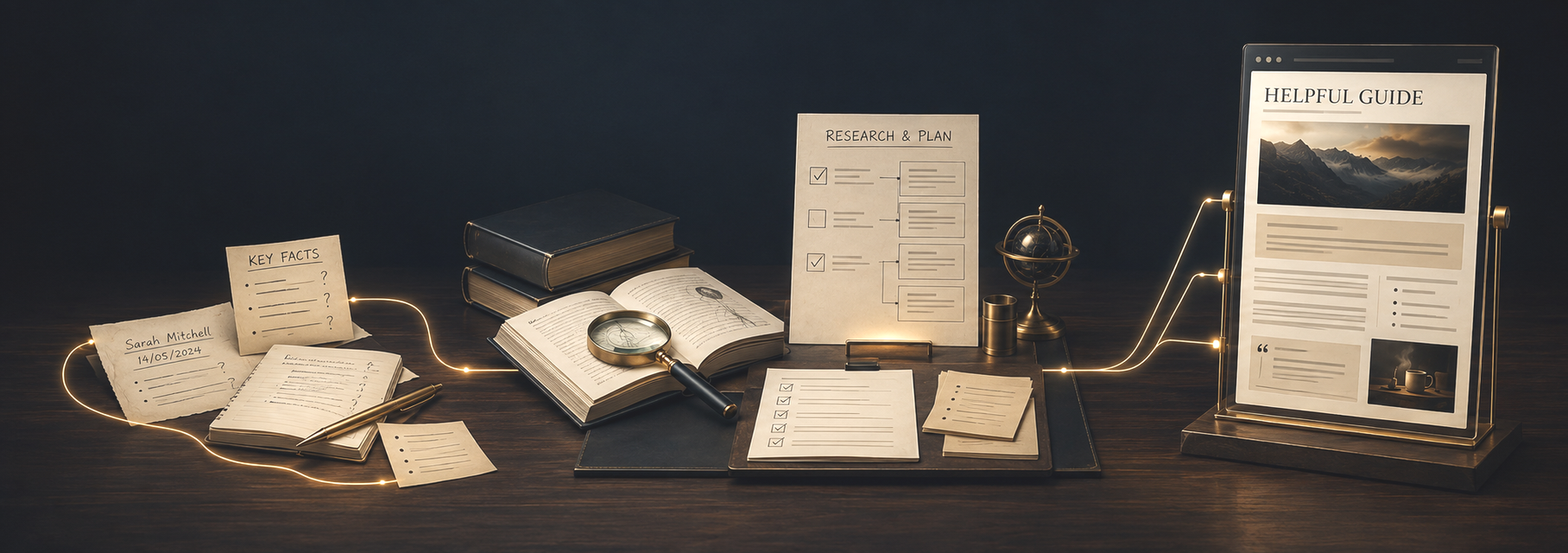
The finished page should feel straightforward. The work behind it usually is not.
- Understand the business and its customers. I begin with genuine customer questions, the problems the business solves and the knowledge held by the people doing the work. Search data can reveal opportunities, but it does not replace first-hand business knowledge.
- Define one clear purpose. I decide who the article is for and what that person should understand or be able to do afterwards. A beginner and a technical professional may search similar words but need very different answers.
- Research the subject properly. I check authoritative primary sources, current regulations or recognised industry guidance, then combine that evidence with the client's experience, photographs and examples. Uncertain information must be resolved, not quietly repeated.
- Design its place within the website. I decide what belongs in the article, what should remain on a service page and what needs a separate guide. I also check that an existing page does not already serve the same search intent.
- Build the information structure. Urgent actions may need to appear first; technical language may need explaining before use; evidence should sit near the claim it supports. The order is planned around how a real person will use the page.
- Write for clarity and interest. Plain English, short sections, practical examples and useful analogies make depth easier to absorb. The voice should sound like the business, not a generic article that could appear on any competitor's website.
- Optimise the complete page. The title, headings, URL, metadata, images, internal links and appropriate structured data should support the same purpose. Nothing should be added merely to tick an SEO box.
- Publish, check and improve. I check indexing, mobile presentation, links and tracking. Search Console and analytics then show which searches reveal the page, how people use it and whether they move towards relevant services.
This is very different from ordering a generic article at a particular word count. The value lies in the research, judgement, information architecture, writing, optimisation and ongoing improvement working together.
One article can support the wider business
A strong article is a long-term source of useful material, not a one-off blog entry.
Its research can be adapted into:
- LinkedIn or other social posts;
- Google Business Profile updates;
- customer emails and newsletters;
- downloadable checklists;
- short videos or diagrams;
- answers to recurring enquiries;
- staff or sales reference material; and
- smaller explanations on relevant website pages.
The original website article remains the complete source. Other channels introduce useful parts of it to people who may never have searched for the full guide.
This is more efficient than inventing unrelated social posts every week. It also keeps the message consistent: the website, search presence, business profile and professional content all reinforce the same areas of expertise.
This connected approach is explored further in
Your Website as the Hub: Building a Connected Local Online Presence.
How to know whether it is working
Traffic matters, but it is not the only measure and often not the most important one.
An article can help before it ranks highly. It may answer a concern, support a quotation, give staff a resource to share or reassure someone who discovered the business elsewhere.
Useful measures include:
- Search visibility: impressions, relevant search queries, clicks and ranking movement;
- Reader quality: engagement time, scrolling, downloads and movement to related pages;
- Commercial actions: form enquiries, telephone or email clicks, quotation requests and sales;
- Assisted value: occasions where the article was part of a longer journey before an enquiry;
- Operational value: repeated customer questions answered more efficiently; and
- Long-term value: continued visits and enquiries months or years after publication.
A specialist article attracting 80 relevant visitors may be more valuable than a general article attracting 2,000 people who will never need the service.
Results also need time. Google says some changes may appear quickly while others can take several months. Judge the page over a sensible period and improve it using evidence rather than constant guesswork.
My guide to small-business SEO timescales explains what you might reasonably look for after the first few weeks, three months, six months and a year.
The aim is to publish something worth finding
A helpful article should solve a problem, improve understanding or help someone make a better decision. If it does that well, it can build familiarity and trust long before the reader is ready to buy.
A connected collection of accurate, well-structured articles can also give search engines clearer evidence of the business's subjects, experience and relevance. It allows service pages to remain concise while the wider website provides the depth that serious customers sometimes need.
But the devil is in the detail.
Research, accuracy, intent, structure, writing, semantic coverage, visual presentation, internal linking and technical optimisation must support one another. Excellent execution can produce considerable long-term value. Careless execution may produce no result, confuse the website or, in more extreme policy-breaking cases, damage search visibility.
I do not treat articles as isolated pieces of copy. I research the subject, decide what information belongs where, build the page around the reader and connect it with the relevant services and wider website.
The aim is not to publish more. It is to publish something genuinely worth finding.
You already have the expertise. I turn it into content worth finding.
I need very little from you to get started. A few rough notes, important dates, names, customer questions and key facts are usually enough. I then research the subject, verify the details, organise the information and create polished content that supports your customers, service pages and search visibility.
Planning a New Business Website?
My principal service is researching, planning and building complete small-business websites. The design, page structure, written content, technical foundations and search visibility are considered together from the beginning.